
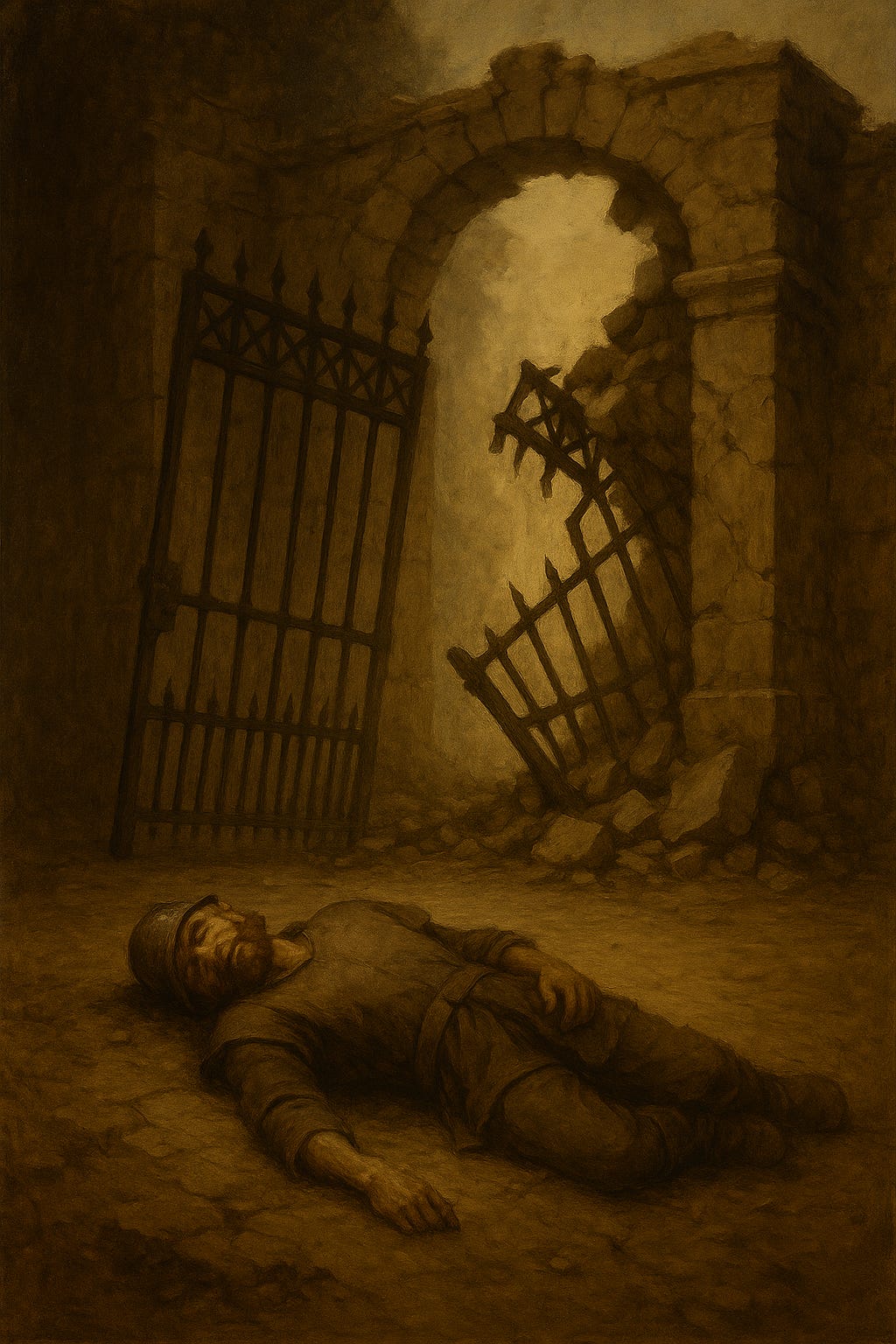
In the American South before 1964, the right to vote was not secured at the ballot box. It was decided at the registrar’s desk. A single official could demand that a Black citizen recite the state constitution, pay a “literacy” fee, or answer questions no white applicant ever faced. The law was not uniform. The gatekeeper was.
That system cracked when the Civil Rights Act passed. Discretion that once belonged to county officials was stripped by federal statute. A registrar could no longer decide who could walk through the door of democracy. The gatekeeper fell.
This is the power of a Gatekeeper Fall.
A Gatekeeper Fall does not seize the throne. It dismantles the barrier that determines who may approach it. History turns on these moments. When party bosses lost control of presidential nominations, candidates no longer needed to kneel for access to the convention floor. When antitrust rulings broke the tollbooths of railroads and phone companies, industries once locked behind monopolies opened to competitors. When social media bypassed newspaper editors as arbiters of opinion, millions no longer needed approval to speak in public. Each time, the actor at the door was stripped of discretion. The gate stood open.
It is important to mark what this move is not. It is not a throne seizure. The throne remains intact. The king may still reign, but the vizier who decided who could see him has lost his power. It is not circumvention. A side door does not count unless it scales to parity. A true fall means the guard is neutralized, not ignored. It is not scandal. A disgraced official replaced by another with the same chokehold is continuity, not collapse.
A Gatekeeper Fall matters because gatekeepers are leverage points. They are often weaker than the throne itself but control who reaches it. Removing them can be cheaper, faster, and more destabilizing than storming the seat of power. The bottleneck shatters. Access floods in.
There are limits. A new gatekeeper may emerge. Some falls are partial, leaving the figure in title but stripped of substance. Sometimes the throne quickly appoints another guard. Yet for the moment of fall, the chokehold is gone.
This is why power struggles so often circle the gate. Lawyers fight for standing not because they crave paperwork, but because standing itself is the key. Political insurgents attack the “machine” not because a chairmanship is glamorous, but because the machine decides who gets to run. Corporations sue to break platform tolls because the toll, not the throne, extracts their margin.
The stakes are not abstract. Every citizen lives in systems structured by gatekeepers. Who may borrow, who may publish, who may enter, who may vote. Each is decided first at the door. To topple that figure is to alter the path for everyone else.
The throne may endure. Yet when the guard at the gate is stripped of discretion, the system itself begins to shift.
If this helped you see the system with sharper eyes, consider subscribing. Each piece offers grounded analysis of how power operates, how rules bend, and how clarity becomes leverage. Understanding the system is not optional. It is an advantage worth cultivating.