
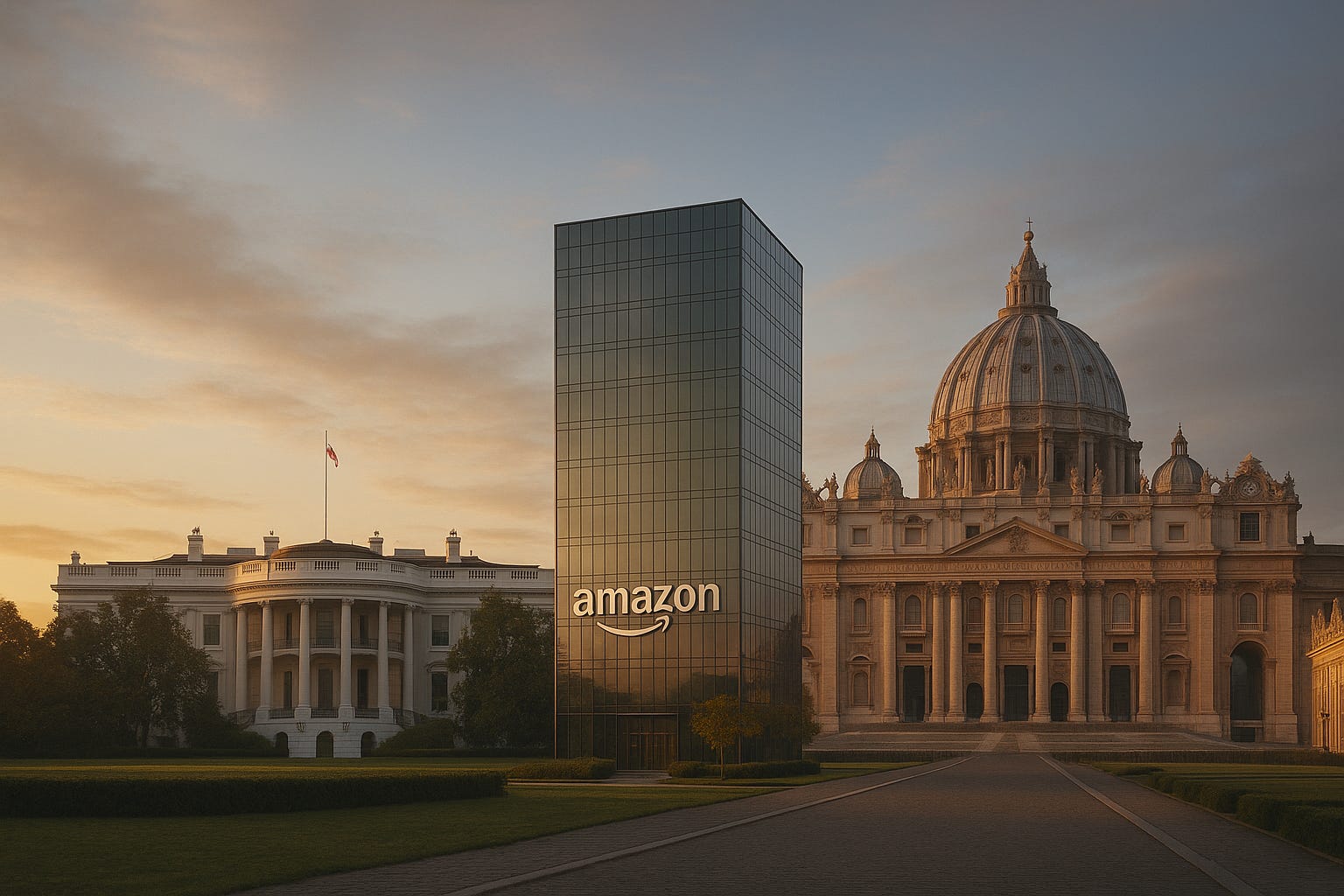
I. The Moment After Motion
Every system begins with a person.
Someone acts with unusual clarity or force, and others adjust around that motion. Over time, repetition replaces authorship. The action hardens into custom. The rhythm becomes routine.
That is when power turns to memory.
Leaders disappear, yet their reflexes remain. A tone of voice becomes a management culture. A rule invented for crisis becomes procedure. A gesture of control becomes doctrine. The human fades while the behavior persists.
Power, at its most durable, survives not through authority but through replication.
II. Bezos and the Machinery of Precision
Jeff Bezos built Amazon by teaching process to think like him.
He replaced instinct with structure, conversation with documentation, and intuition with measurable rhythm. The Six-Pager and S-Team review were not meeting formats; they were instruments of cognition. They ensured that every decision moved at his preferred speed and in his preferred language.
The organization learned to think and argue as he did. Even in his absence, his framework continued to run the company. Amazon became a mechanism of his temperament.
That is the highest form of power: when a person’s reasoning becomes the default logic of a system. The same design can also turn defensive. Once rhythm becomes unquestionable, judgment ceases to matter. The institution begins to protect the process more than the purpose.
III. The Founders and the Architecture of Fear
The same pattern shaped the United States.
Its Founders did not merely design a government. They converted their private anxieties into public machinery. Madison’s suspicion of factions, Hamilton’s appetite for central power, and Washington’s instinct for restraint became an operating system of limits and counterweights.
The Constitution is less a document than a map of emotion.
It encodes fear of dominance, mistrust of ambition, and faith in process. Two centuries later, those emotions still govern every argument about reform. America’s rhythm is the memory of its founders’ fears.
The result is stability that often feels like paralysis, continuity that can border on delay. The United States remains a system built to distrust its own strength.
IV. The Papacy and the Bureaucracy of Belief
Long before either, the papacy showed how belief could become administration.
Popes such as Gregory I and Innocent III transformed faith into structure. They built offices, legal codes, and routines of worship that allowed the Church to operate across continents and centuries.
Liturgy became governance. Ritual became record. The Church learned to act through memory long after its founders were gone. Its endurance rests not only on faith but also on its capacity to preserve the shape of authority even when authority changes hands.
No modern organization matches that level of procedural survival. The Church’s continuity remains its most powerful argument.
V. Navigating Systems That Remember
To move effectively inside large systems, one must understand what they remember and why.
Every organization carries the imprint of its original architect. The unspoken rules, the pace of approval, and the definition of risk all descend from an earlier mind. Those who recognize that inheritance can operate with precision. Those who ignore it mistake inertia for principle.
The most strategic actors learn to read institutional memory as terrain. They know when to move with the current and when to disrupt it. They sense when repetition is serving purpose and when it has become a substitute for thought.
To navigate power inside a system is to know which memories are still alive and which are only reflex.
VI. The Edge of the Individual
The study of individual power ends here, at the border where instinct becomes structure.
Beyond this line lies a different kind of motion, slower and procedural, where rules begin to think for themselves. It is the realm where systems develop instincts of their own.
No framework can fully contain that terrain. Human motive, ego, and strategy mutate too quickly for any model to capture them completely. Yet tracing how personal will becomes collective reflex reveals the hidden architecture that guides nearly every institution on earth.
Every lasting system began as someone’s motion.
Every rule was once an improvisation that worked too well to abandon.
Every structure, whether built on profit, policy, or faith, carries the rhythm of its founder’s mind.
Those who study power must learn to see these imprints, to separate the living from the automatic, and to decide when memory still serves motion.
A system forgets it was made by people the moment it begins to believe it cannot be changed.
If this helped you see the system with sharper eyes, consider subscribing. Each piece offers grounded analysis of how power operates, how rules bend, and how clarity becomes leverage. Understanding the system is not optional. It is an advantage worth cultivating.