

I. The Stage of Conquest
On November 17, 2023, the board of OpenAI shocked the world.
They removed Sam Altman, the company’s CEO and co-founder, claiming he had not been “consistently candid.”
To the outside world, it looked like an abrupt governance dispute.
To anyone who studies power, it was the collision of two instincts: the drive to expand and the fear of losing control.
For years, Altman had embodied the expansion instinct.
He rose through Y Combinator by turning startup culture into ideology. He told founders that building fast was not recklessness but virtue.
He then carried that same hunger into OpenAI, where he pursued the frontier of artificial intelligence with missionary calm.
He had learned that conquest in modern systems does not require armies. It requires narrative, velocity, and inevitability.
II. The Architecture of Expansion
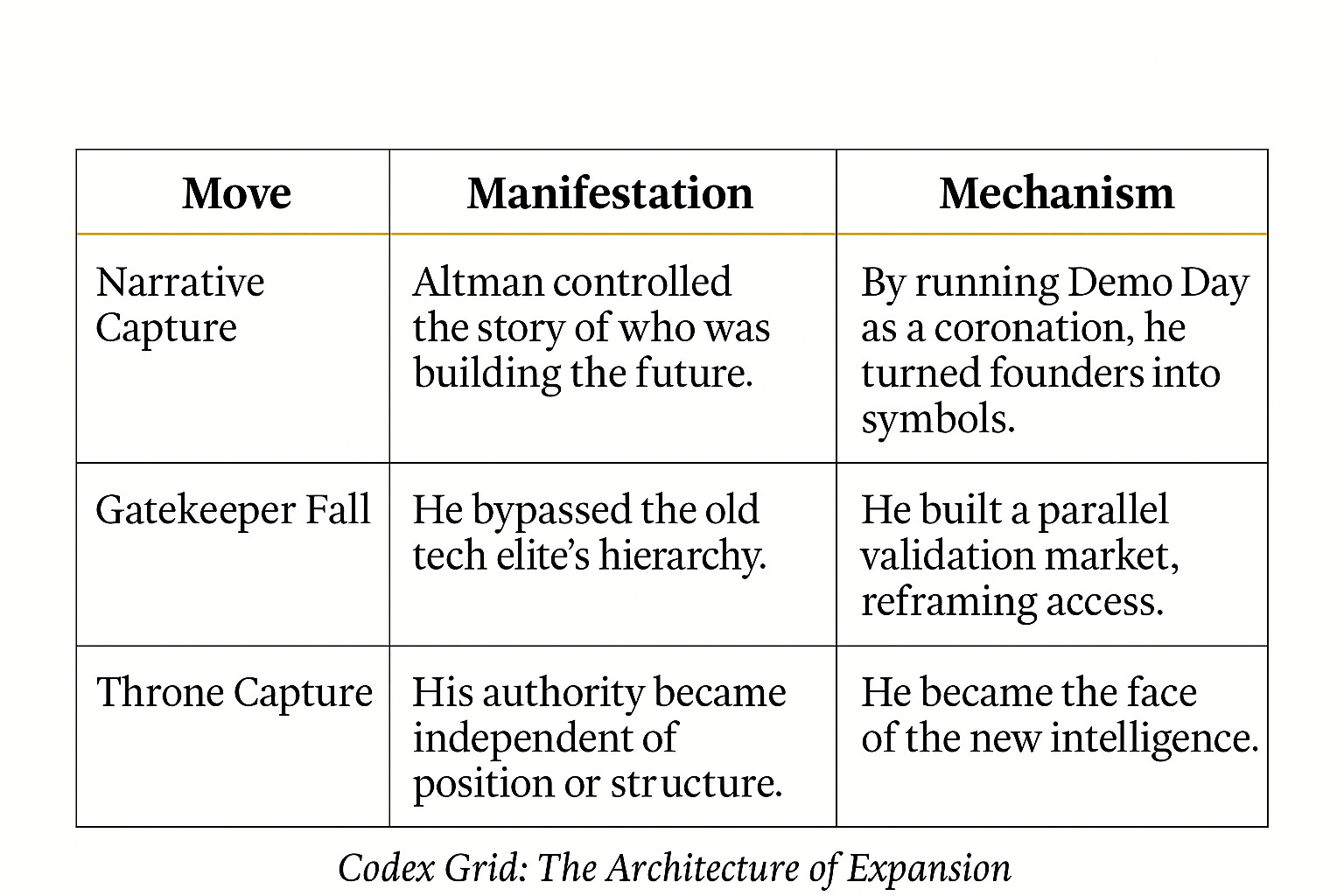
Narrative Capture – Altman defined the story of artificial intelligence before governments could.
In interviews and testimony, he spoke about AI as destiny, not product but epoch. That language placed him above competitors and regulators alike.
Gatekeeper Fall – He bypassed traditional tech hierarchies.
Instead of courting venture-capital elites, he built direct alliances with sovereign actors: Microsoft, academic labs, and global media.
Each relationship weakened the old gatekeepers and made him the new interpreter of legitimacy.
Throne Capture – When ChatGPT launched, he became the face of intelligence itself.
The headlines were not about technology but about prophecy, the human who had opened the future.
Conquest complete.
By late 2023, OpenAI was no longer a company. It had become a phenomenon orbiting one man’s credibility and that is precisely when preservation begins.
III. The Instinct of Preservation
Power burns hottest right after victory.
Altman now carried a new burden. The structure built on his momentum could collapse under its own weight.
Preservation began quietly, first as internal diplomacy, then as restraint.
He negotiated the pace of model releases, balanced investor demands with ethical rhetoric, and spent as much time with senators as with engineers.
He learned that in preservation, silence is often the move.
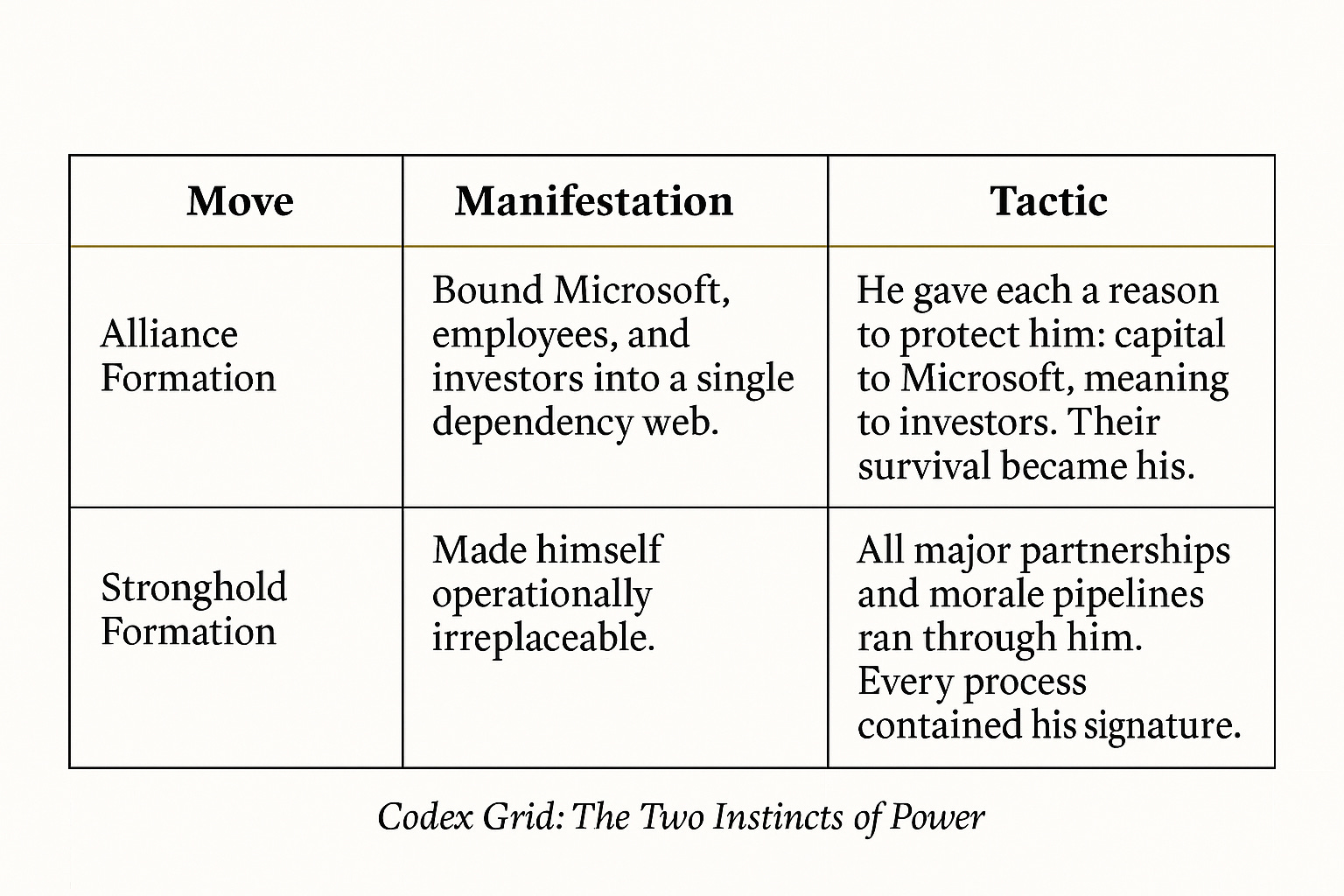
That is how the preservation instinct operates.
It replaces charisma with structure. It trades reach for density.
When the board finally acted, seeking to reassert moral control, the walls he built activated.
Nearly every employee threatened to quit.
Microsoft offered him an immediate division to run.
Investors warned the board that its mission meant nothing without momentum.
Within days, the same forces that once amplified him forced his reinstatement.
His conquest had become its own defense.
IV. The Inner Shift
What makes Altman’s case instructive is not that he returned, but how he returned.
He re-entered quieter, measured, less visible.
He began speaking in plural language: we, our, the team.
The man who had once embodied expansion now practiced containment.
Preservation required new tactics.
Selective Disclosure – Offering information that calmed allies without empowering adversaries.
Symbolic Concession – Allowing new board members to join, creating the appearance of oversight while maintaining operational control.
Pacing Strategy – Slowing external announcements to give regulators and partners psychological recovery time.
These are the arts of defense: subtle, procedural, invisible to casual observers.
They keep victory alive without provoking another coup.
V. The Metabolism of the Individual
Altman’s arc shows that the Individual Codex is not a ladder but a loop.
Every move—Narrative Capture, Gatekeeper Fall, Throne Capture, Alliance Formation, Stronghold Formation—feeds into the next cycle of risk.
Conquest creates exposure.
Preservation creates rigidity.
Only those who can feel the turn survive it.
The conqueror’s danger is overreach.
The guardian’s danger is inertia.
Power collapses when either instinct refuses to yield to the other.
VI. The Law of Alternation
Every powerful individual must learn this conversion.
Conquest wins attention. Preservation earns duration.
The first expands through vision. The second survives through restraint.
Each instinct, if overused, destroys the other.
Law: The powerful endure only if they can convert the energy of conquest into systems of defense before the threat arrives.
Power does not rest. It alternates between conquest and containment.
If this helped you see the system with sharper eyes, consider subscribing. Each piece offers grounded analysis of how power operates, how rules bend, and how clarity becomes leverage. Understanding the system is not optional. It is an advantage worth cultivating.