
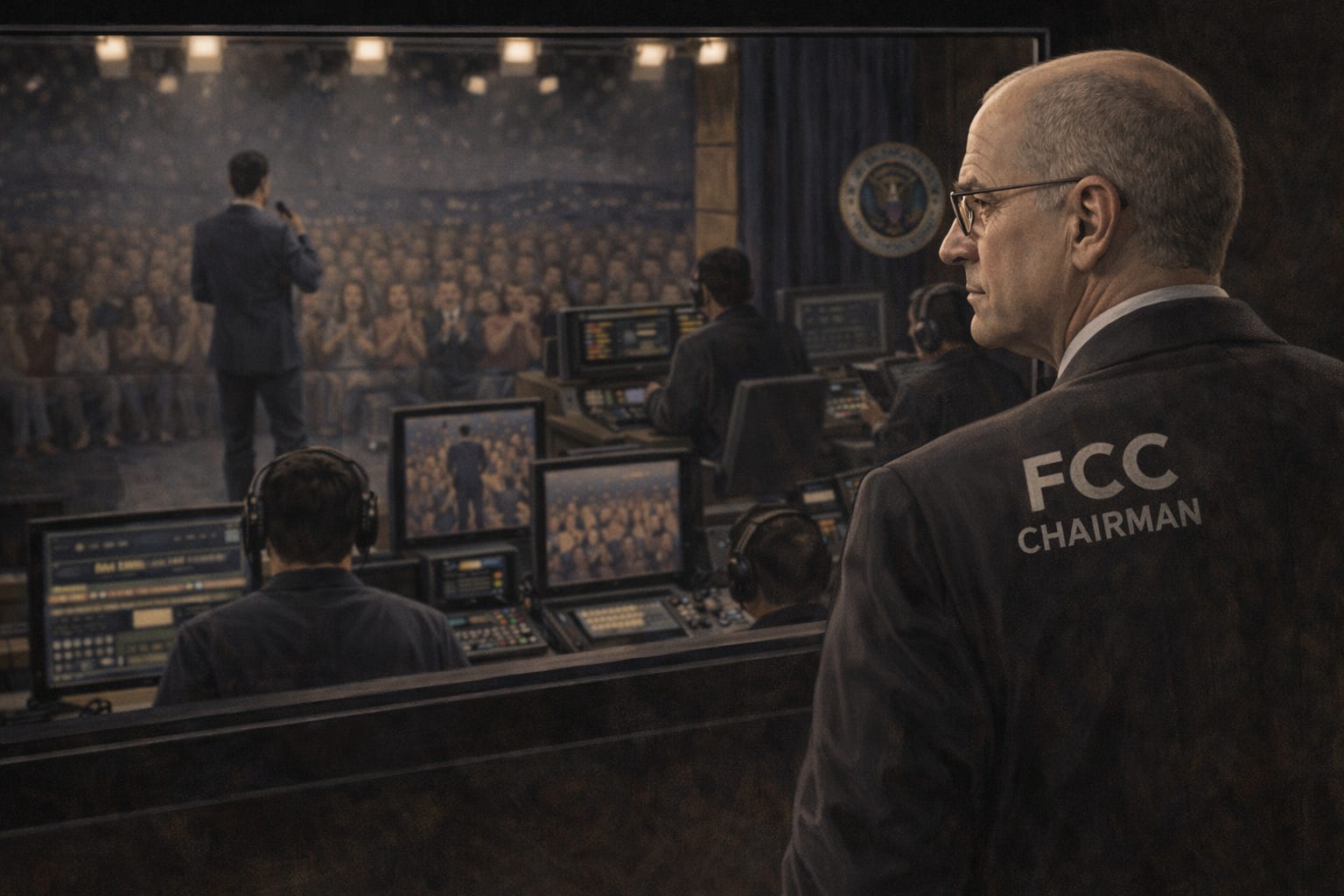
I. The Signal the FCC Chose to Send
In September 2025, conservative activist Charlie Kirk was shot and killed at a public event. The killing was widely reported and immediately politicized. Public attention intensified quickly, and the event became part of a broader cultural conflict rather than remaining a discrete act of violence.
Days later, a late-night television host addressed the aftermath on air. The remarks were interpreted by many as dismissive of the seriousness of the killing and of the political community surrounding it. Political figures and commentators called for consequences. The focus shifted from criticism of speech to demands for institutional response.
The demand that followed was specific. If a line had been crossed, the broadcaster should be held accountable through its license. That framing is what drew the Federal Communications Commission into the episode.
The FCC did not open a case. It did not announce an investigation. It did not allege a violation of broadcast content standards. Instead, senior FCC leadership made public remarks reminding broadcasters that licenses are conditioned on serving the public interest. The statement was not accompanied by findings, procedural steps, or a description of next actions.
Several local affiliates temporarily preempted Jimmy Kimmel Live!. The program was reinstated shortly thereafter. The FCC took no further steps.
The episode ended without enforcement.
II. What Did Not Move
Nothing about the legal structure governing broadcast content changed during this episode.
The FCC did not revise its indecency standards. It did not reinterpret statutory authority under the Communications Act. It did not alter the criteria governing license renewal or revocation. No binding obligations were added. No tolerance thresholds were adjusted. No enforcement posture was formally announced.
If legal obligations had changed, compliance would have followed automatically. If enforcement priorities had shifted, consequences would have appeared downstream.
Neither occurred.
The institutional architecture remained intact. The agency did not commit itself to any action that could be challenged, reviewed, or fixed as precedent.
That fact sharply limits what this episode can be understood to represent.
III. Influence Without Commitment
Despite the absence of formal movement, the episode produced observable effects. Affiliates reassessed exposure. Network counsel revisited license obligations that had not been actively discussed in years. Executives evaluated whether visibility itself had become a liability independent of content rules.
None of this behavior was compelled. No broadcaster was ordered to act. No sanction was specified. The FCC did not escalate when the preemptions were reversed.
This is where many readings go wrong. The instinct is to frame the episode as either overreach or retreat. Both framings assume the institution was attempting to enforce something.
It was not.
What occurred was the invocation of authority without deployment. The FCC referenced a power it unquestionably holds without committing to its exercise. That move sits between silence and enforcement. It is neither accidental nor confused.
IV. The Category This Reveals
This episode is best understood as the use of what I refer to as a Draft Signal.
A Draft Signal is not a change in obligation and not an act of enforcement. It is the deliberate reference to real institutional authority to influence behavior while preserving discretion.
The mechanics are simple. The authority must be genuine. The consequence must be plausible. The institution must retain deniability by doing nothing further. When those conditions are met, behavior can adjust without the institution incurring the costs of formal action.
That is what occurred here. The FCC referenced license authority it clearly possesses. It did not specify violations or consequences. It did not escalate. Nothing binding happened. Behavior still shifted.
This is not an anomaly. It is a recognizable institutional move.
V. Draft Signals and Future Optionality
Draft Signals serve a second function that is easy to miss.
They create a record of concern without creating a record of action. By speaking publicly, an institution establishes that an issue has entered its field of attention. If it later chooses to escalate, the earlier signal can be cited as notice rather than novelty.
That does not mean escalation is inevitable. Most Draft Signals dissipate. Many never harden into anything more.
What matters is that the option is preserved.
Institutions use this technique when immediate commitment would be costly, but silence would appear unresponsive. The Draft Signal allows the institution to remain formally unchanged while keeping future paths open.
In this sense, the signal is not only about present influence. It is also about maintaining strategic flexibility.
VI. What This Means for You
This episode is not primarily about late-night television or a single controversy. It is about how institutions operate when authority is real but expensive to deploy.
First, do not treat Draft Signals as evidence that the rules have changed. Legal obligations remain where they were unless the institution commits itself formally.
Second, do not dismiss Draft Signals as empty rhetoric. They indicate where institutional attention has moved and where future pressure may concentrate.
Third, watch for repetition and sharpening. A single signal often fades. Repeated signals, narrower language, or the addition of process indicate possible escalation.
Finally, separate method from outcome. Whether an institution ultimately acts is less important than understanding how it exercises influence before acting at all.
The FCC did not revoke a license.
It reminded broadcasters that it could.
That distinction is the starting point for understanding how modern institutions manage pressure.
If this helped you see the system with sharper eyes, consider subscribing. Each piece offers grounded analysis of how power operates, how rules bend, and how clarity becomes leverage. Understanding the system is not optional. It is an advantage worth cultivating.