
The Rule:
The bargain changes after leaving becomes expensive.
I have a theory that when a product starts getting worse, that is not always because the company has lost its way. Sometimes it is because the company finally figured out that you are not going anywhere. That is actually much worse.
The Seduction
Think about the early days of any service people get addicted to. They are wonderful to you. Cheap prices. Great service. Free features everywhere. Somebody in customer support practically wants to come to your house and tuck you into bed. The company is desperate. It needs you, it needs growth, and it needs people telling their friends how amazing the product is. Then you get used to it, and that is when the fun starts.
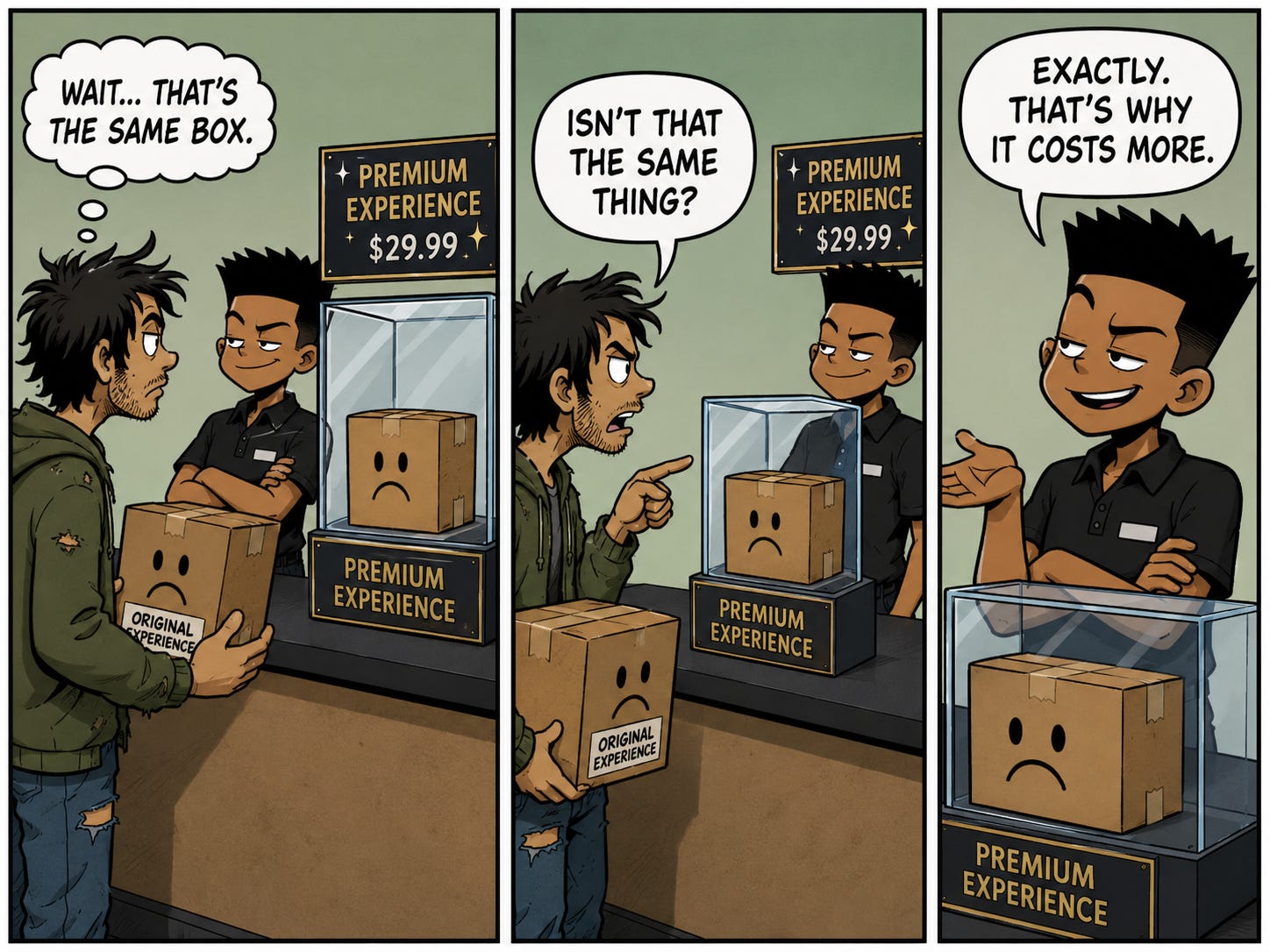
Now the price creeps up. The free tier suddenly develops a few mysterious disabilities. Ads start appearing where there were no ads before. The thing that used to come with your subscription is now part of some “premium experience.” Customer service becomes a maze designed by someone who appears to hate customers. Naturally, the company explains that all of this is being done to “improve the experience.” Sure.
Amazon is a perfect example because it did such a good job that it has broken my brain. When Amazon launched Prime in 2005, it cost $79 a year and came with unlimited two-day shipping. Prime later rose to $99, then $119, and eventually $139 a year, which is still the current annual U.S. price. Meanwhile, I can now order something from my couch and have it appear at my house in two days, and somehow that can annoy me. My wife will look at me like I have failed the family because I picked two-day shipping when same-day was available.
We are ridiculous. Amazon made us ridiculous.
That is the genius of it. Amazon did not just make delivery better. It made the old standard feel unacceptable. By 2018, Amazon said Prime had surpassed 100 million paid members worldwide, and by 2021 Bezos said it had passed 200 million worldwide. Once enough people reorganize their lives around a service, the company no longer has to keep winning you every day. It just has to avoid irritating you enough to make you leave.
Then came one of my favorite examples of corporate audacity. In 2024, Amazon started putting ads into Prime Video. If you wanted the same ad-free experience you had before, you could pay another $2.99 per month. The product gets a little worse, and then the company offers to sell you the old version back. Beautiful.
The Dependency
That is why I look at AI right now and laugh a little. People are amazed at how much these companies are giving away. You can have software help you write, research, code, analyze documents, plan your day, explain something complicated, and do work that would have taken hours not that long ago. Sometimes for free. Sometimes for the price of dinner.
According to Stanford’s 2026 AI Index, 88% of surveyed organizations now use AI in at least one business function, up from 78% the year before. OpenAI was reporting more than 800 million weekly ChatGPT users by late 2025. That is a rather spectacular amount of habit formation for a technology that most people had never touched a few years earlier.
How generous.
Maybe they are just wonderful people. Or maybe the industry is still in the part where it needs us to become incapable of imagining work without it. That is the more interesting possibility to me because if AI becomes normal enough, the company does not need to keep making the product better forever. It just needs to know how much worse it can make it without forcing you to leave.
Maybe the best model eventually goes behind the more expensive plan. Maybe your current plan gets slower. Maybe limits appear. Maybe there are ads. Maybe the tool starts gently steering you toward other paid services. Maybe the version you loved still exists, of course. You can absolutely have it. Just upgrade.
By that point, what are you going to do? Go back to doing everything manually out of principle? I know myself. If I get used to AI saving me hours every week and someone raises the price, I am going to be extremely offended for approximately eleven minutes. Then I am going to pay.
The Harvest
That is why I think people misunderstand product degradation. We look at a worse product and assume management has become stupid, greedy, or both. Sometimes management may simply have discovered that the product was better than it needed to be. Imagine spending years giving customers an incredible experience and then slowly realizing they would stay if you gave them 90% of it. Then 85%. Then maybe 80%, provided you do not push too quickly.
Congratulations. You have found margin.
The really valuable thing these companies may be building is not the product at all. It is our intolerance for living without it. Once you cannot imagine going backward, they no longer have to keep asking how much you love the service. They can start asking how much you will tolerate.
If history is any indication, the answer is probably: a lot, quite a lot.