
Helpless. Overwhelmed. Resigned.
That low-grade dread you carry? It is not imagined.
Since childhood, we have been told that civilization, its systems, its laws, its rituals, exists for a reason. That the machine works. Maybe it does. Yet the gears are spinning faster than ever, and we, the people it is supposed to serve, often find ourselves jammed inside, chewed up by complexity we cannot explain, much less navigate.
We are born into systems we did not build. Financial systems. Legal systems. Healthcare networks. Educational pipelines. Zoning laws. Insurance forms. Tax codes. We swim in them the way fish swim in water, unaware until the tide turns and we find ourselves gasping.
It is not that systems are inherently evil. The more advanced a society becomes, the more systems it requires. Yet these structures now evolve faster than our ability to understand them.
In past civilizations, life may have been harder in material terms, but the fundamentals of survival, family, and contribution were more accessible. Today, even the basics, owning a home, accessing healthcare, protecting your rights, can feel like boss-level obstacles in a game we were never taught to play.
We live in the most materially abundant period in human history. There is more food, more data, more money, more tools than ever before. Yet millions are shut out.
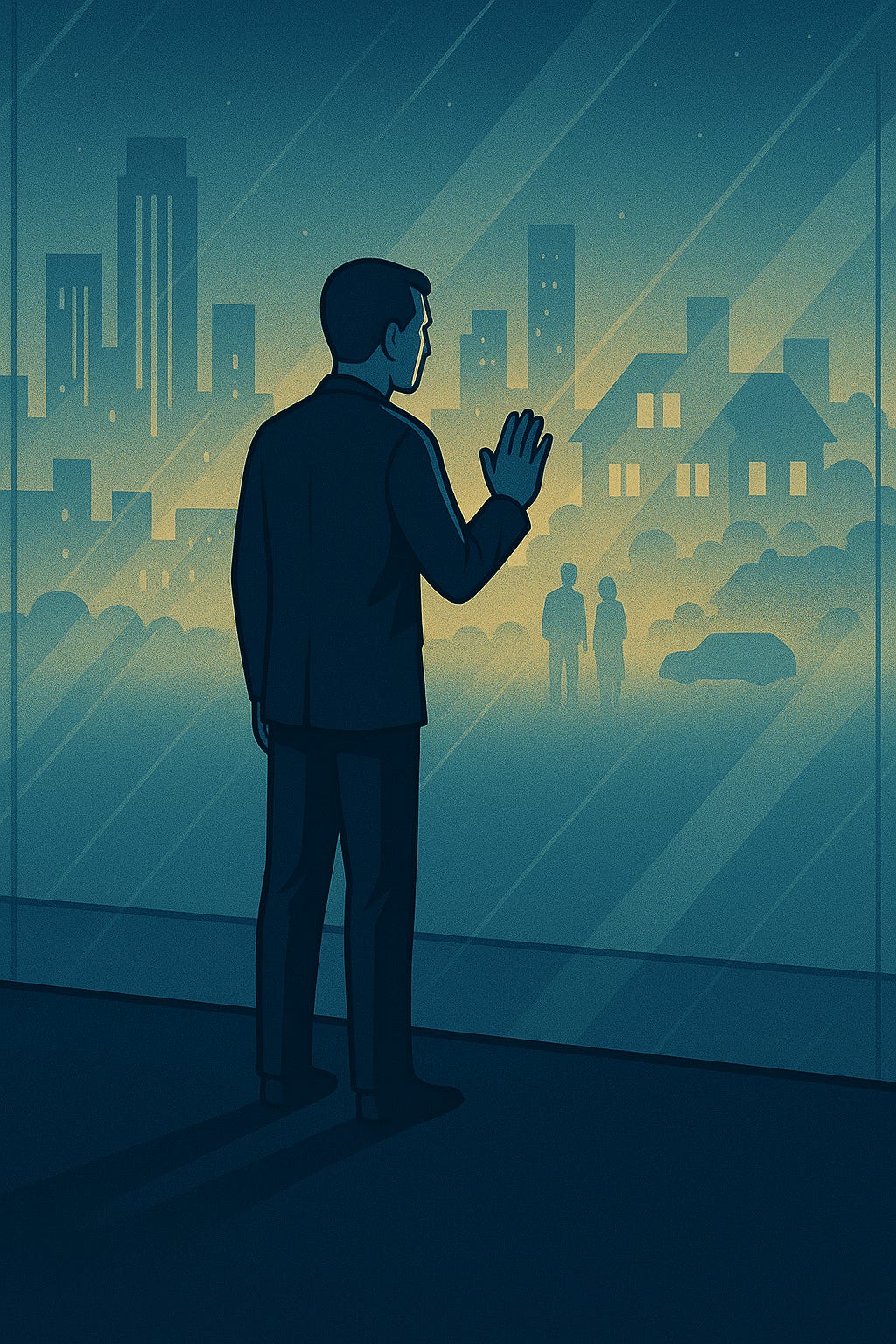
This is not just about inequality. There have always been haves and have-nots. The wound feels deeper now. Why? Because the wall between abundance and struggle is no longer opaque. It is glass.
We can see through it. We know what is on the other side, the lifestyle, the security, the freedom. We stream it in 4K. We scroll past it every day. Yet we cannot touch it. We are kept just outside.
It is not the unfairness that gnaws at the soul. Life has always been unfair. It is the helplessness. The not knowing why the wall is there. Who built it. Whether there is a way through. Is it climbable? Is it guarded? Is it real, or a trick of the light?
Why are they on the other side? Were they born there? Did they jump the wall? Cheat the system, or learn to master it?
I do not pretend to have all the answers. But I have spent time inside one of the sharpest, most complex systems in existence: the law.
As a mass tort attorney, I represent ordinary people, workers, parents, patients, often pitted against multibillion-dollar corporations and bureaucracies. I have spent years inside the engine room of America’s justice machine. Sometimes it delivers. Sometimes it does not. Sometimes justice feels like an accidental byproduct of powerful interests trying not to lose too much.
I have had wins that left me humbled. Losses that made me question the entire game. Above all, I have had a front-row seat to how systems work and who they work for.
The legal system is one of humanity’s oldest formal structures. At its best, it helps resolve conflict. At its worst, it is a fortress written in a dialect only a priesthood of insiders can read.
Most people’s interaction with the law? Bafflement. A void. A black box. That is not by accident. Like many of the systems that rule our lives, the law benefits from staying obscure. Our ignorance is not collateral damage. It is part of the design.
And that is the real issue. We are ruled, quite literally, by what we do not understand.
To be clear, we do not need to master everything. No one can be an expert in economic policy, insurance contracts, or zoning codes. Complexity is part of modern life. Yet the pace, scale, and opacity of these systems are growing, accelerated by technology, bureaucracy, and a lack of transparency.
Some people have learned how to use this complexity to gain extraordinary wealth and power. Maybe that is the price of progress. Maybe it is even deserved.
But if that is true, what do we tell the people stuck outside the glass? That they simply were not clever enough? Did not read enough fine print? Did not hustle hard enough?
I do not buy that. I do not think it is sustainable.
So what now? Do we just scream into the void?
Maybe. I would rather light a candle.
This project, whatever shape it takes, is about naming the systems. Learning their logic. Mapping their weak points. Arming people with the insight that these mechanisms, while intimidating, are not divine.
They were built by human hands. Which means they can be unbuilt, reworked, hacked, or at the very least, understood.
Because once you understand a system, you are no longer powerless. You may not tear the wall down. But you can stop pretending it is not there. You can start seeing it for what it is.
The Glass Wall lets us see what is on the other side.
Not everything you see is clear. Power has a way of distorting the view, making the path look simple, the obstacles invisible, the struggle your fault.
I have spent years inside the machinery behind that distortion, the law.
I have seen how rules, written, hidden, and manipulated, can turn opportunity into illusion.
This project is about bringing those rules into focus.
About reading them, questioning them, and understanding how they shape the world around us.
Because rules are not just words on paper.
They decide who qualifies, who gets excluded, who stays stuck outside the glass.Only when you learn the rules, really learn them, can you stop stumbling in the dark.
The rules shape the world. Know them, or be shaped by them