
I. Two Systems, Same Crisis, Unequal Paths
During the pandemic, two major loan forgiveness programs promised relief. One, targeted individuals with long-standing student debt. The other, the Paycheck Protection Program, offered support to businesses and nonprofits. Both used federal authority. Both framed relief as essential. But their execution exposed a structural divide.
Millions of student borrowers had to meet income thresholds, tax verification standards, and evolving eligibility criteria. The program stalled repeatedly due to lawsuits, judicial interventions, and administrative backlogs. Some borrowers were approved, but their balances remained visible months later, awaiting final clearance. Each step required time, persistence, and sometimes legal counsel. Forgiveness came slowly, if at all.
Meanwhile, the PPP program forgave almost 90 percent of loans, ranging from a few thousand dollars to millions, within a single year. Many recipients were law firms, private schools, churches, or franchises. According to the U.S. Small Business Administration, more than $750 billion in debt was forgiven with minimal review and a simple certification form.
This was not corruption. It was policy design.
Both systems had rules. One gave its users a checklist. The other offered a side door. The difference was not just who needed help. It was who the system expected to wait and who it quietly permitted to leave early.
This is the architecture of selective permission. It is not just about relief. It is about who receives administrative friction and who receives a glide path.
II. What Rules Appear to Do
Rules are the scaffolding of legitimacy. They signal that process governs power. When followed, they appear to separate authority from favoritism.
This belief is embedded in modern governance. It tells us that justice is a function of transparency and predictability. The assumption is that rules act like boundaries, visible, stable, and universally enforced.
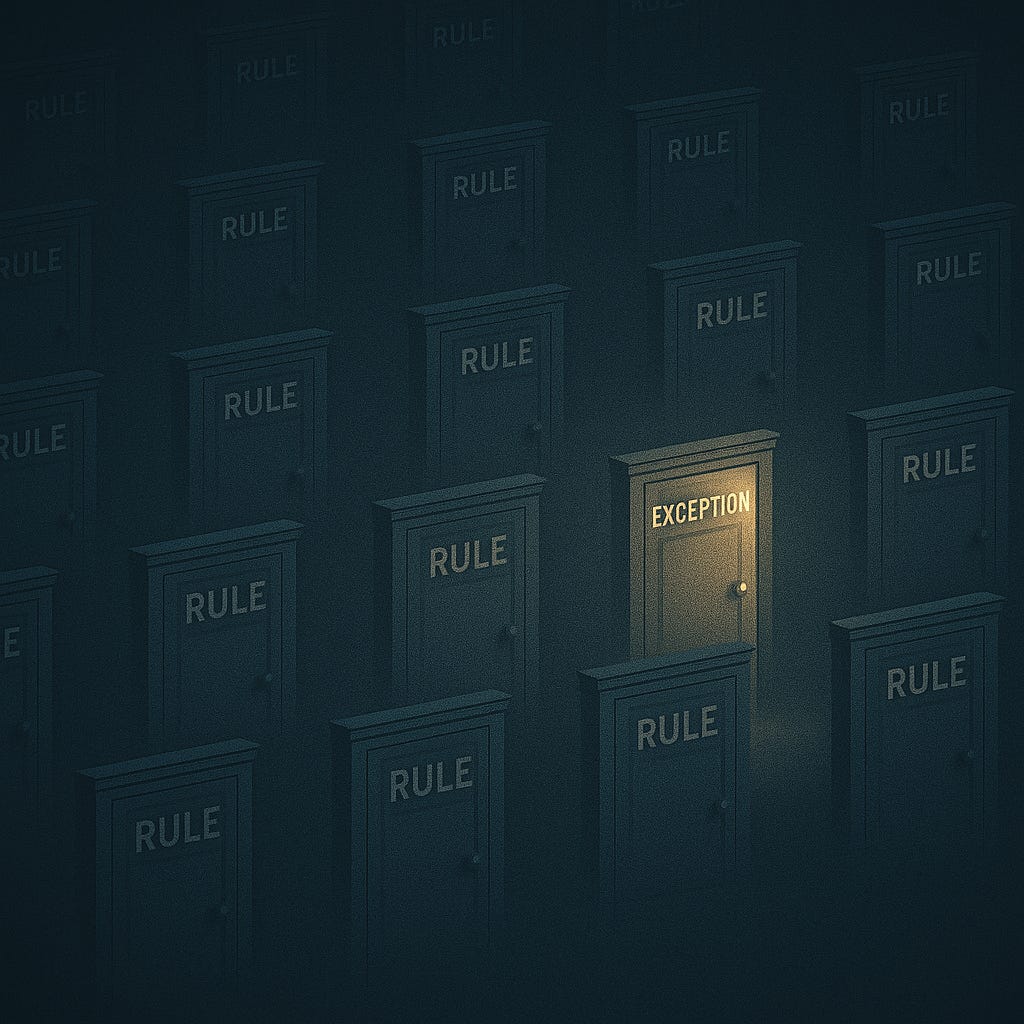
Yet in reality, rules function more like stage lighting. They direct attention. They tell the audience where to look. What lies in shadow is not erased. It is simply not discussed.
In the shadows live the exceptions. Waivers. Discretion. Quiet allowances.
A citizen may be denied a mortgage because of one missed document. A senator may receive clearance on a stock sale with no scrutiny. Both processes follow protocol. Only one carries friction.
Power does not dismantle the rule. It preserves the appearance. What it shifts is the enforcement, the delay, or the relief. This is not deviation. It is design.
III. A Pattern Older Than Law
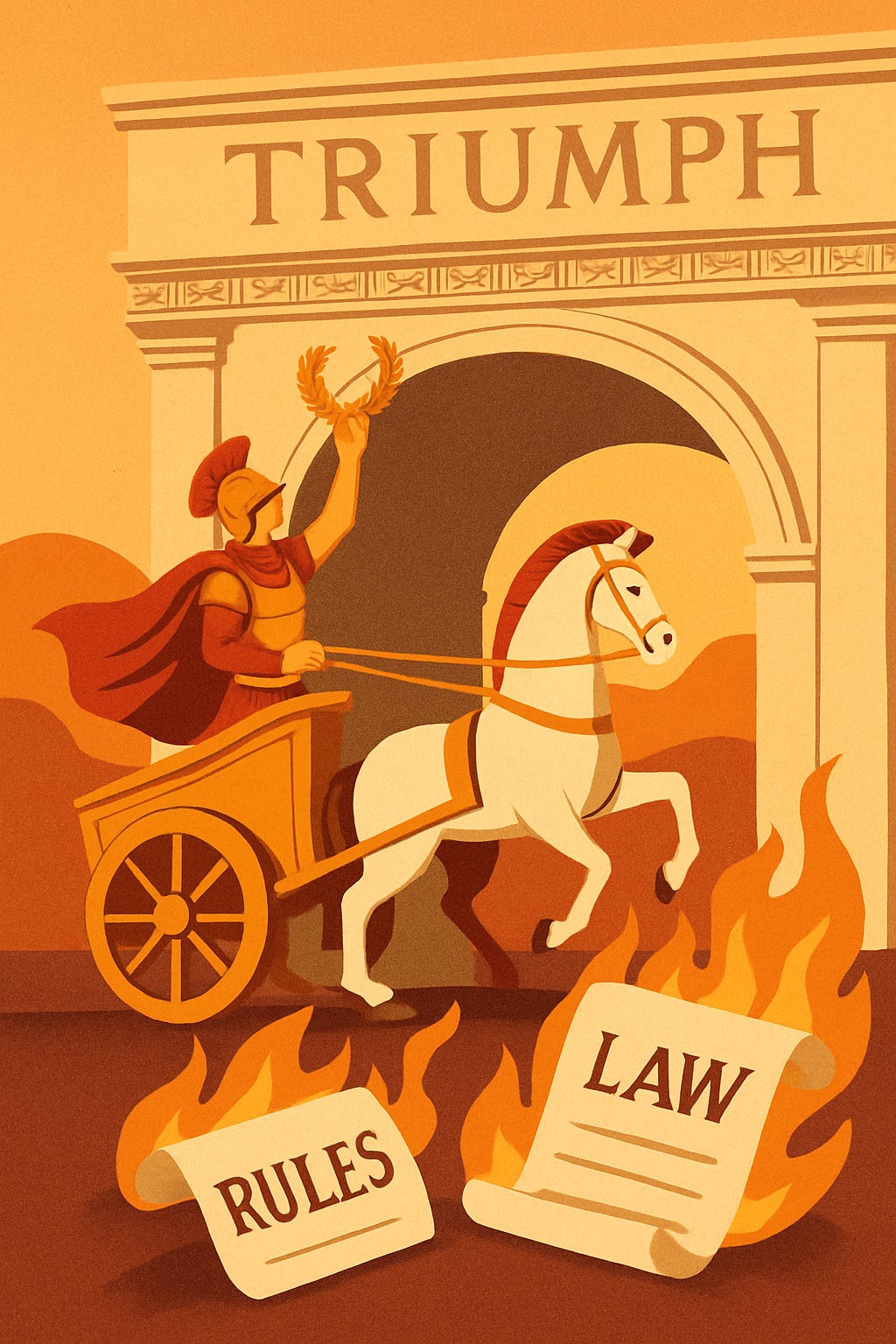
Power often speaks through exceptions, not edicts. In ancient Rome, victorious generals were granted a triumph, a public parade that suspended ordinary legal constraints. According to World History Encyclopedia, during the Republic the Senate granted triumphs only to generals who met specific conditions. Later, emperors reserved them for themselves and their loyalists. What began as a rule-bound reward became a symbol of imperial exception.
That ceremony was not mere theater. It was a public reminder that even law had a ceiling.
Today, triumph takes different forms. It arrives in backdated authorizations, quietly waived compliance reports, and strategic non-enforcement. What was once announced with trumpets now arrives as a line item.
A healthcare agency may issue an Emergency Use Authorization. A federal office may delay a penalty to avoid political fallout. These are not accidents. They are permissions coded into structure.
The modern triumph is a form. It lives in plain sight and still, it elevates.
IV. The Three Quiet Tools of Exception
Today’s institutions manage exception through three main tools: waivers, exemptions, and discretion.
Waivers allow the rule to remain in theory but disappear in practice. During the COVID-19 pandemic, the U.S. Department of Health and Human Services invoked the PREP Act to shield pharmaceutical companies from liability. The waiver was framed as emergency response, but it redefined accountability for years to come.
Exemptions are permanent carveouts built into the rule from the beginning. For example, Title IX prohibits sex-based discrimination in education. But religious institutions may request exemption if they claim the rule violates their beliefs. These exemptions transform civil rights law from a universal standard into a conditional tool.
Discretion is the most potent and least visible tool. It allows a decision-maker to enforce, delay, or ignore the rule entirely without explanation. Prosecutors choose which cases to pursue. Inspectors decide whom to penalize. Administrators interpret deadlines flexibly for some and rigidly for others. Discretion allows the rule to speak loudly but move selectively.
These three tools do not sabotage law. They operationalize it. But once applied unevenly, they become the true infrastructure of influence.
V. When the Exception Becomes Infrastructure
In February 2021, a brutal winter storm overwhelmed Texas’s energy grid. Millions lost power and water. Hundreds died. While the event was initially framed as a natural disaster, it quickly revealed the impact of decades of policy choices.
Texas operates its own electric grid through the Electric Reliability Council of Texas (ERCOT). By avoiding integration with federal regulators, the state sidestepped compliance costs and seasonal mandates. For years, this autonomy was framed as flexibility.
But that same autonomy allowed Texas to avoid winterization upgrades. When extreme weather struck, the infrastructure collapsed. Gas lines froze. Wind turbines failed. Blackouts spread.
This was not just a crisis. It was the outcome of an exception that became invisible until it failed.
VI. Why This Rule Matters
The belief that rules apply equally is not just civic ritual. It is governance glue. It anchors institutional credibility in everything from jury selection to zoning laws.
When the public perceives rules as unequal, trust fractures. When exception feels predictable, fairness feels aspirational.
This is not about outrage. It is about oxygen. Systems require legitimacy to function. That legitimacy does not die in scandal. It dissolves in patterns.
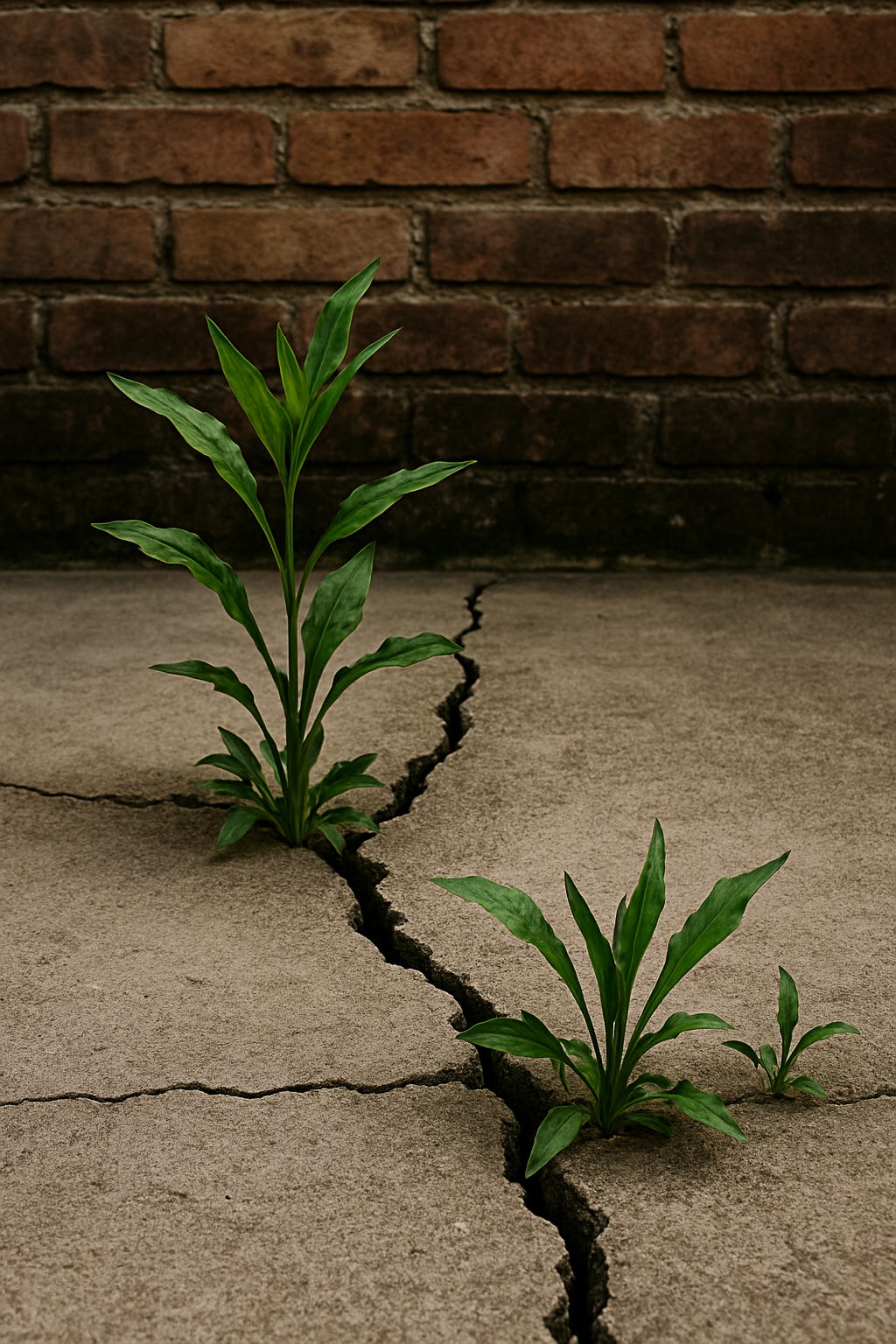
Still, no society escapes exceptions. Even in a utopia, humans will interpret, delay, and bend. That is not failure. It is nature. Exceptions are like weeds. They return with the seasons. The challenge is not to erase them. The task is to manage them.
Some carveouts, like Roman triumphs or presidential pardons, are tolerated because their beneficiaries are visible. Others fester when reserved for the well-connected but invisible to the public. When exceptions begin to sequester too much access or concentrate relief too narrowly, systems lose coherence. People stop trusting not only the process but the idea of fairness itself.
You may benefit from these carveouts. Most professionals will at some point. The real test is not whether you use them. The test is whether you recognize when they become the rule.
There is a cost to exposing this structure. Those who do so loudly risk being labeled difficult or disruptive. If you are too precise, too public, too persistent, the gatekeepers may tighten. Polished pressure must walk the line between effectiveness and exposure.
Still, silence has a cost as well. If the system convinces the public that the rulebook remains intact while quietly rewriting its outcomes, then power wins twice. First by design. Then by denial.
The deeper truth is that every society will host exceptions. That is not always malign. It is a human adaptation. The real question is whether exceptions serve as pressure valves or exclusive corridors. If they are visible, occasional, and broadly distributed, they may reinforce institutional flexibility. If they remain hidden and concentrate advantage, they will corrode public trust.
Civilization can survive unfairness. What it cannot survive is disbelief in the rules themselves.
Most rulebooks do not collapse. They calcify. They remain intact on paper while slowly bending in practice. The danger is not that we lose all structure. It is that we continue to recite rules that no longer govern outcomes. That gap between stated law and lived experience is not just technical. It is emotional. It becomes resentment. When too many see the rules flex for others but not for them, they do not wait for permission. They withdraw consent.
VII. Who the Rule Waits For
Power does not need to change the rule.
Power only needs to change who is allowed to bend it.
Most exceptions are not announced. They are permitted. Some arrive in writing. Others arrive with a nod.
To understand modern governance, do not ask what the rule says. Ask who the rule waits for. Ask who the rule hurries along. Ask who escapes it altogether.
Then ask who is watching.
If this helped you see the system with sharper eyes, consider subscribing. Each piece offers grounded analysis of how power operates, how rules bend, and how clarity becomes leverage. Understanding the system is not optional. It is an advantage worth cultivating.
Sources
CBS News: PPP loan forgiveness cost nearly double what Biden’s student debt relief would have. https://www.cbsnews.com/news/ppp-loan-forgiveness-student-loan-relief-cost-comparison/
Forbes: Borrowers Face Huge Delays Applying for Student Loan Forgiveness
https://www.forbes.com/sites/adamminsky/2021/03/11/borrowers-face-huge-delays-applying-for-student-loan-forgiveness-program/SBA: PPP loan forgiveness summary data
https://www.sba.gov/funding-programs/loans/covid-19-relief-options/paycheck-protection-program/ppp-dataWorld History Encyclopedia: Roman Triumphs and their evolution
https://www.worldhistory.org/Roman_Triumph/Congressional Research Service: PREP Act and COVID liability shields
https://crsreports.congress.gov/product/pdf/LSB/LSB10443U.S. Department of Education: Religious exemptions under Title IX
https://www2.ed.gov/about/offices/list/ocr/docs/t9-rel-exempt/index.htmlTexas Tribune: Texas power grid got crushed because its operators didn’t see the need to prepare for winter https://www.texastribune.org/2021/02/16/texas-power-grid-failure/