
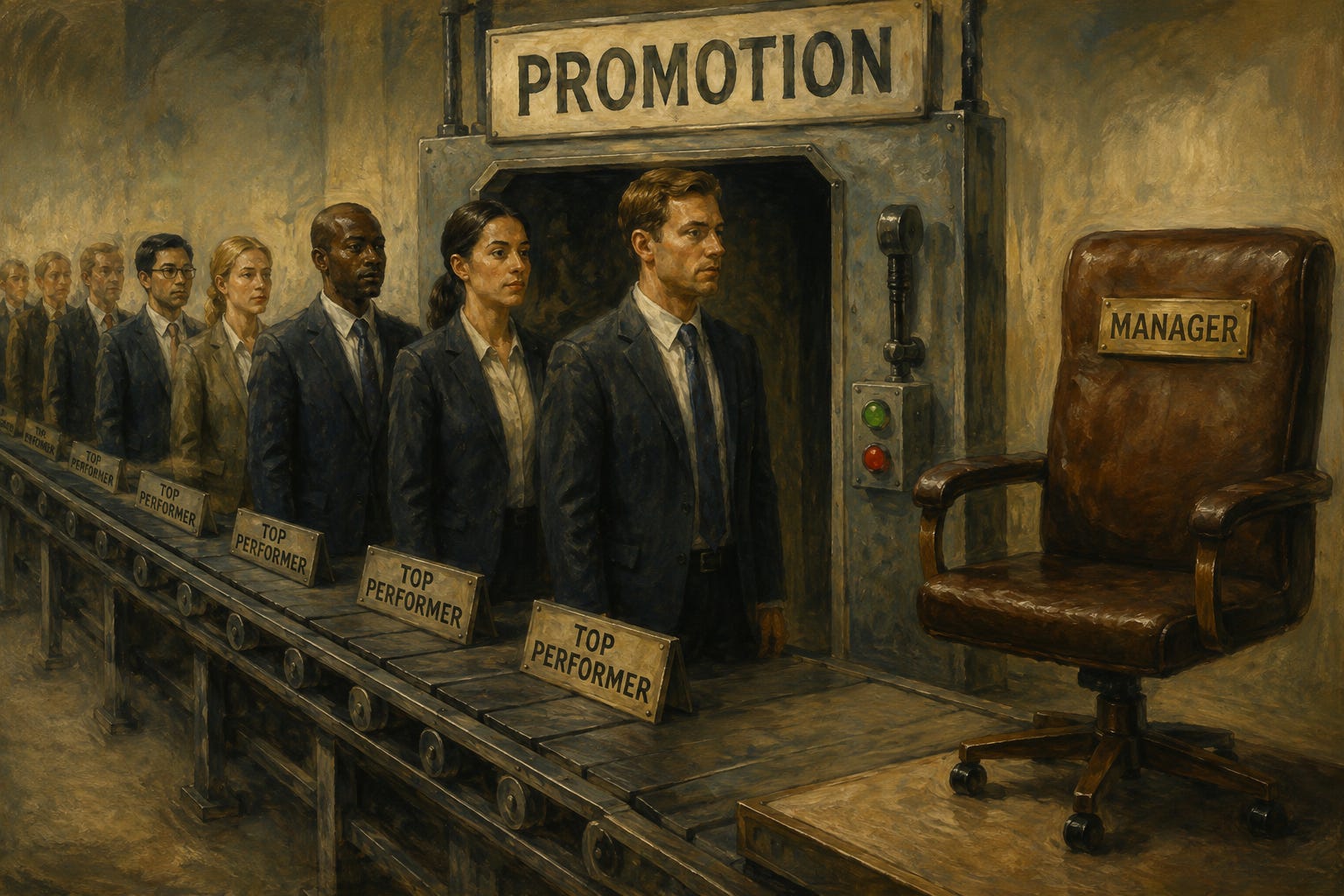
You have probably seen some version of it.
The strongest salesperson becomes a manager and the team deteriorates. The brilliant engineer struggles to delegate. The gifted lawyer who could handle any case turns out to be impatient with associates who cannot work at the same speed.
The usual conclusion is that the company chose poorly. Sometimes it did. But when organizations make the same apparent mistake repeatedly, the problem may be larger than the judgment of one executive or selection committee.
We tend to assume that a promotion is intended to identify the person most capable of performing the next job. Organizations also use promotions to reward past performance, retain valuable employees and show the rest of the workforce that achievement leads somewhere.
The best candidate for those purposes may not be the best manager.
What the Research Found
A major study published in The Quarterly Journal of Economics examined the performance and promotion histories of sales workers across 131 firms. The researchers found that stronger sales performance made workers significantly more likely to be promoted into management. Yet the qualities that predicted success as an individual salesperson did not necessarily predict success leading a sales team.
After exceptional salespeople became managers, the performance of their subordinates tended to decline. Employees whose sales records showed greater collaboration generally became more effective managers, but they were less likely to receive the promotion. The companies appeared to give more weight to visible individual output than to characteristics that better predicted managerial performance. The researchers described the findings as evidence of the Peter Principle, the familiar idea that employees are promoted until they reach a role they cannot perform as well.
The study did not establish that employers simply failed to recognize the difference. Its authors identified a more difficult tradeoff. Promoting top performers can strengthen employees’ incentive to perform well in their current positions. Choosing a less productive salesperson because that person appears likely to become a better manager might improve team leadership, but it could weaken the visible connection between performance and advancement.
A decision that produces the wrong manager can therefore still serve other organizational purposes.
Promotion Looks Backward and Forward at the Same Time
Management selection should be forward-looking. The relevant question is whether a candidate can coach employees, delegate work, resolve conflicts, allocate responsibilities and improve the performance of other people.
Promotion often looks backward. It recognizes what the employee has already produced.
That difference matters because management is not simply a more advanced version of the employee’s existing work.
An effective individual contributor may be rewarded for personal speed, technical judgment and the ability to solve problems without assistance. Managers must resist the urge to do everything themselves. They must allow others to use different methods, explain decisions more than once and address poor performance without simply taking the work back.
A great salesperson can rely on personal relationships and instinct. A sales manager must help ten other people develop those capabilities.
A great lawyer can take command of a difficult case. A managing attorney must distribute work, develop associates and accept that the strongest legal solution may not be the one the team can execute.
The promotion may confer higher status while placing the employee in an occupation for which the employee was never evaluated.
This remains common. In a 2026 Gallup survey of frontline supervisors, 65 percent said they had reached supervision primarily because of their frontline performance or experience. Only 30 percent said supervisory skills or experience had been the principal reason. Gallup also found lower engagement among supervisors chosen mainly for frontline performance than among those selected for supervisory capability.
Why Companies Keep Doing It
The simplest answer is that many organizations have not developed another credible way to let excellent employees advance.
Pay, titles, prestige and decision-making authority tend to rise together. Remaining an individual contributor can eventually mean reaching a compensation ceiling while watching less accomplished colleagues move above you because they were willing to supervise people.
Management becomes the route to recognition by default.
This creates pressure on both sides. The employee may accept a role that does not fit because declining it looks like a lack of ambition. The employer may offer the role because greater pay or status is difficult to justify within the employee’s existing position.
The promotion solves the immediate problem. The organization retains and rewards someone valuable. The consequences appear later, after the employee is responsible for a team.
Reversing the decision is also difficult. A return to the former position is commonly understood as a demotion, even when it would place the employee back in work that better matches their abilities. The senior leader who sponsored the promotion may resist admitting the mistake. The company may add training, narrow the manager’s responsibilities or rely on stronger subordinates rather than reconsider the original match.
By then, the organization is no longer deciding only where one employee performs best. It is protecting the credibility of a decision it has already announced.
What to Understand Before Accepting a Promotion
Employees often focus on whether they deserve the promotion. A more useful question is whether they want the work that comes with it.
Before accepting a management role, ask how people in the position actually spend their time. The title may represent advancement while the daily work consists largely of hiring, performance documentation, scheduling, budgeting, conflict resolution and repeated conversations with struggling employees.
Ask how success will be measured. Will you still be evaluated on your own production, or on the development and output of the team? Will you have authority to make staffing decisions, or will you be accountable for results without control over the people and resources producing them?
It is also worth testing the work before taking the title. Leading a project, mentoring a junior colleague or coordinating a small team can reveal whether you enjoy producing results through other people. The experience may also give you evidence of management ability that is more relevant than your individual performance record.
Most importantly, determine why the promotion is being offered. The organization may see you as a promising leader. It may also be trying to reward you, retain you or solve an urgent vacancy. Those motives are not necessarily improper, but they should not be mistaken for a careful assessment of fit.
An offer based primarily on retention may create room to negotiate for higher compensation, greater autonomy, a senior specialist title or responsibility for major projects without assuming direct supervision.
Is the Alternative Path Real?
Many organizations now describe themselves as having dual career tracks: one for management and another for employees who continue advancing through technical or professional expertise. SHRM recommends such tracks as a way to reward and retain strong individual contributors who may not want or suit management.
The existence of a second track on an organizational chart does not mean it carries equal weight.
Employees should look at who receives the highest compensation, who participates in important decisions and who controls assignments and resources. Can a senior specialist earn as much as a manager? Are respected employees actually using the technical track, or is it where careers go after management has been ruled out?
A company with a genuine alternative will allow expertise to produce meaningful advancement without requiring control over direct reports. A decorative alternative offers new titles while reserving influence, money and status for management.
That distinction tells employees whether they truly have a choice.
When You Have Already Taken the Wrong Role
Realizing that management does not suit you is not proof that you lacked ability. It may mean the organization confused excellence in one kind of work with readiness for another.
Still, leaving management requires careful framing because institutions tend to interpret downward movement as failure.
The strongest case is based on value rather than discomfort. Identify the work in which you are most effective, explain how a different role would use that ability and propose a transition that solves an organizational problem. A return to individual work is easier to defend when it is presented as a deliberate deployment of scarce expertise rather than an escape from responsibility.
That conversation will also reveal something important about the employer. An organization that values contribution should have room for someone to admit that a role is a poor fit. An organization that recognizes only upward movement may prefer an ineffective manager to an exceptional employee who stepped off the ladder.
What Better Promotion Systems Do Differently
A more effective process separates recognition of past work from selection for future work.
Strong individual performance should matter. It should result in compensation, autonomy and opportunity. But management candidates should also be evaluated for the capabilities the new position requires.
That means looking for evidence that someone can improve other people’s performance, not merely outperform them.
It means allowing potential managers to try the work before the move becomes permanent.
It means providing management preparation before problems emerge rather than treating training as a repair tool after promotion.
It also means creating a respectable route back. Not everyone who experiments with management will want to remain there. A system that treats every return as humiliation encourages people to conceal poor fit until the damage becomes more expensive.
Companies will continue promoting excellent workers into management because promotion is doing more than filling a vacancy. It rewards achievement, encourages effort and gives employees a visible path through the organization.
The practical lesson is not that promotions are meaningless or that strong performers should refuse them. It is that the title may be answering a different question from the one you think the company has asked.
Being worthy of recognition does not automatically make management the right reward.
Before accepting the next rung, examine the work attached to it.