
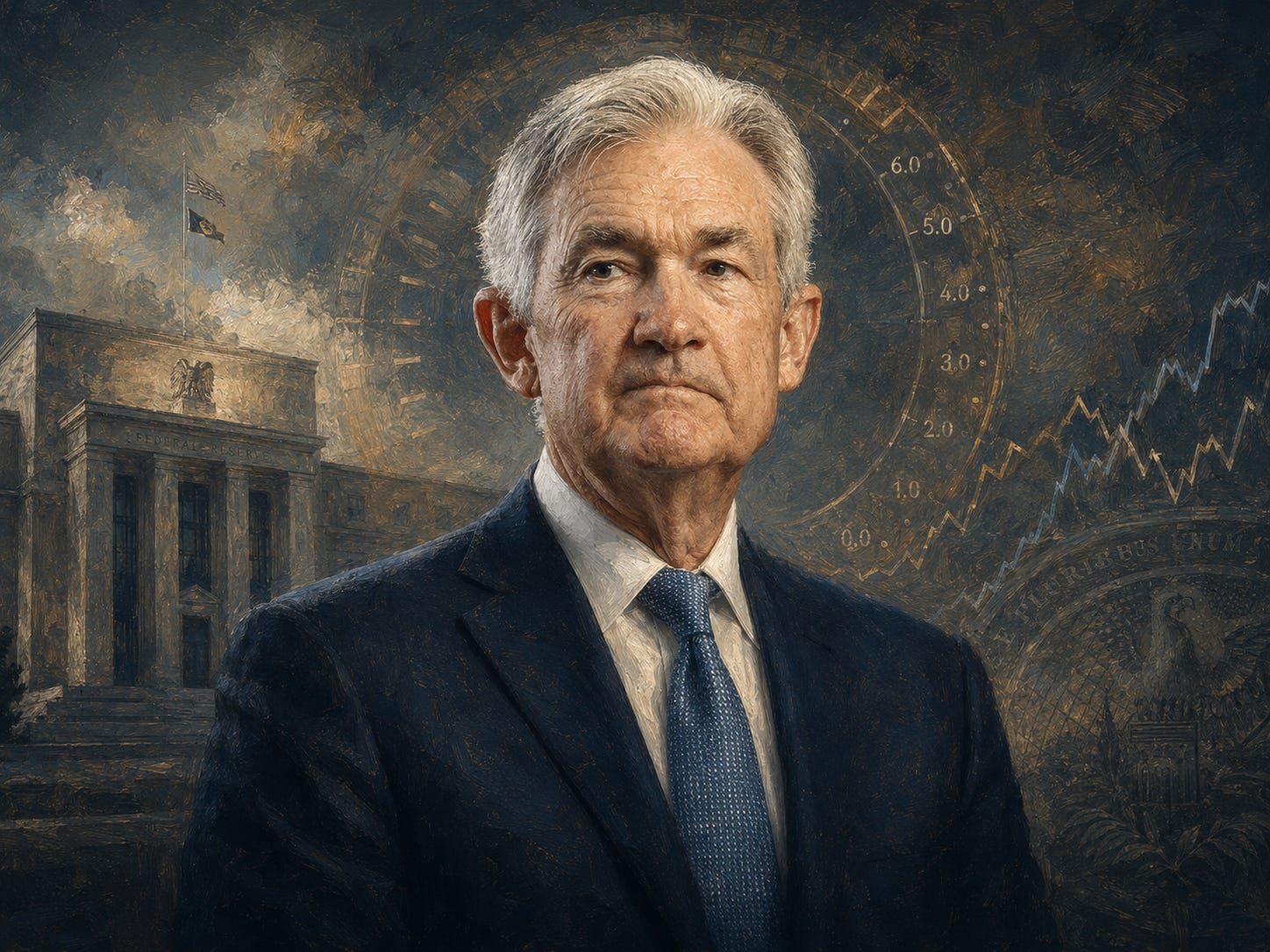
Jerome Powell did not gain power by looking like a conqueror.
He did not found the Federal Reserve. He did not arrive as an economic prophet or the chosen instrument of a political movement. His rise was quieter. Powell became powerful the way certain institutional figures become powerful: by becoming useful to many groups without becoming the property of any one of them.
That is not the same as being nonpartisan. Nonpartisan is too thin a word. Powell’s real advantage was that he was difficult to reduce.
He was a lawyer by training, not an academic economist. He moved through law, investment banking, private equity, Treasury, fiscal-policy work, and then the Federal Reserve Board. Each stage added a different credential. Finance gave him market fluency. Treasury gave him government fluency. Fiscal-policy work gave him crisis fluency. The Fed Board gave him institutional fluency. By the time he became chair, he was not merely a nominee. He was a bundle of reassurances.
That is how institutional power often begins. Not with dominance. With reduced resistance.
Republicans could see a former Treasury official from a Republican administration and a man with private-sector experience. Democrats could see someone already serving inside the Fed, steady enough not to threaten the institution’s legitimacy. Markets could see a person who understood their language. The Fed could see a chair who would not turn the office into a personal brand.
This was his opening. He became the person enough factions could tolerate.
That sounds modest only to people who have never watched institutions work. In a polarized system, tolerability is not weakness. It is passage. The most exciting figure may command devotion. The most ideological figure may command a faction. The tolerable figure crosses the room.
Powell gained power by being difficult to classify.
A figure who is easy to classify is easier to attack. Hawk. Dove. Wall Street man. Trump man. Biden man. Political actor. Academic technocrat. Market servant. Inflation obsessive. Labor protector. Once the label sticks, the opposition knows where to aim.
Powell avoided that trap. He had private-sector credibility without seeming merely captive to Wall Street. He had Republican roots without becoming reducible to Republican politics. He was nominated by Trump, then renominated by Biden. He helped rescue markets in crisis, then punished markets when inflation made comfort dangerous.
This was not charisma. It was category evasion.
Powell first joined the Federal Reserve Board in 2012. That matters. He did not leap straight into the chairmanship as an outsider imposed upon the institution. He spent years inside the system before becoming its public face. He learned the rhythms of the Board, the language of monetary policy, the relationship between the chair and the committee, and the strange power of central-bank communication.
His rise was not only the result of appointment. It was the result of apprenticeship.
This is the first layer of Powell’s power.
He gained power by becoming useful to every faction and owned by none.
The second layer is how he kept it.
Powell understood what the Federal Reserve actually sells. The Fed does not merely sell policy. It sells belief. Markets react not only to what the Fed does today, but to what they think the Fed will do tomorrow. Banks, investors, presidents, businesses, and households all try to read the institution before the institution acts. In that world, the chair’s voice is not decoration. It is machinery.
Powell became powerful when he became the voice people had to interpret.
That is different from being loud. The Fed chair cannot sound like a politician, a pundit, or a wounded executive. The office requires distance. It requires a style that makes uncertainty feel governed. A chair who speaks too freely cheapens the words. A chair who performs too eagerly becomes part of the market’s panic.
Then inflation arrived and tested the whole structure.
The early inflation period damaged the Fed’s credibility. Powell’s task became harder than ordinary leadership. He had to tighten financial conditions after years of cheap money. He had to tell markets that comfort was not the mandate. He had to tell politicians that growth could not be purchased with permanent inflation. He had to tell the public that pain might be necessary to restore price stability.
This is where Powell’s power hardened.
Many leaders keep power by avoiding blame. Powell kept power by absorbing blame into the office. He did not become a showman. He returned to the mandate: price stability, maximum employment, financial stability, institutional credibility. The more pressure gathered around him, the more important it became that he not look pressured.
That was not passivity. It was command under restraint.
The power of Powell’s office was never gentle. Higher rates reach into mortgages, credit cards, business loans, valuations, payrolls, and household plans. Technocratic authority often wears calm language while distributing real pain. Powell is not a hero in this profile. He is more useful than that. He is an example of how institutional legitimacy turns painful decisions into accepted decisions.
The latest attacks made this clearer.
They were meant to shrink him into a vulnerable individual: a chairman under pressure, a holdover, a bureaucrat standing in the way, a man who could be threatened into departure. Powell’s answer was to refuse that scale. He did not treat the fight as a personal injury. He treated it as an institutional test.
That distinction changed the battlefield.
A personal dispute can be dismissed as ego. A policy dispute can be fought on partisan lines. A fight over interest rates can be framed as a disagreement over growth, inflation, or the election calendar. A fight over whether the central bank can be pressured because its chair refuses to deliver the policy a president wants is different. That fight activates the defenders of the institution itself.
This was Powell’s deeper survival move. He made the pressure against him prove the need for the independence he was defending.
The more his critics personalized the attack, the more Powell depersonalized his response. He stood inside the office. He returned to the mandate. He let the conflict become larger than himself. That is how a man under attack can grow stronger. He becomes the place where the institution draws the line.
Powell did not merely survive because he was calm. He survived because his calm forced the system to choose what it was actually defending. Not Jerome Powell the man. The Federal Reserve’s independence. The credibility of monetary policy. The idea that some decisions must be insulated from the election calendar.
This is the second layer of Powell’s power.
He kept power by converting pressure into proof.
Before the attacks, Powell was a central banker with a mixed record: pandemic rescue, inflation misjudgment, aggressive rate hikes, political criticism, market frustration. After the attacks, he became easier to defend as something larger: a boundary marker between monetary policy and political command.
A direct attack can destroy a weak figure. It can also consecrate an institutional one.
Powell survived because he made the fight bigger than himself.
The Powell Playbook: How to Get Power and Keep It
1. Become Useful to Several Camps Without Becoming Captive to One
Powell’s rise began with a rare kind of institutional usefulness. Different groups could trust him for different reasons. He was not threatening enough to be blocked, but serious enough to be elevated. That is not weakness. In many institutions, the first gate is not devotion. It is tolerability.
The move is to become legible to more than one faction. Do not make yourself so factional, so theatrical, or so personally expressive that only one camp can imagine trusting you. Inside institutions, the person who can be accepted by several groups often gets access before the person adored by one.
2. Learn the Machinery Before You Become Its Voice
Powell spent years inside the Fed before becoming its public face. That’s important because institutions are not governed only by titles. They are governed by calendars, committees, approval chains, informal vetoes, and the quiet people who know where decisions actually happen. Powell’s later authority was built on his earlier apprenticeship.
The move is to map how an important decision really travels from idea to approval. Find the committee. Find the gatekeeper. Find the informal veto. Find the person whose objection can kill the proposal before anyone votes. The microphone matters only after you understand the lever.
3. Make Yourself the Interpreter, Not the Performer
Powell’s power was not merely that he made decisions. It was that people needed him to explain what the institution meant. That is a higher form of authority. The performer seeks attention. The interpreter controls meaning. Powell’s words mattered because markets, politicians, and institutions had to pass through his explanation before they could decide what the Fed had done.
The move is to become the person who can translate complexity into direction. Do not merely report what happened. Explain what it means, what standard governs it, and what comes next. The person who controls interpretation often controls the room after the decision has already been made.
4. When Attacked, Move the Fight to Institutional Ground
Powell’s survival came from refusing the personal frame. He did not make the attacks about his feelings, pride, or private reputation. He made them about the independence of the institution and the credibility of the office. That made him harder to isolate. His critics wanted to attack a man. Powell made them look like they were attacking a boundary.
The move is to ask what larger principle the attack threatens. Process. Independence. Fairness. Standards. Role clarity. The powerful response is not always to strike back. Sometimes it is to enlarge the frame until defending you becomes a way for the institution to defend itself.
The Lesson
Jerome Powell’s power is easy to miss because it does not flatter the age. It is not viral. It is not theatrical. It does not arrive with the glamour of disruption or the heat of conquest. It is the colder power of the institutional survivor: the person who enters through acceptability, learns the machinery, becomes the interpreter, and then refuses to let attacks remain merely personal.
That is why Powell’s ascent and ability to keep power within the Fed was chronicled in Rulocracy. He shows that getting power and keeping power are different arts.
To get power, he became useful to many factions and owned by none.
To keep power, he made the most dangerous fight of his life bigger than himself.
The lesson is not to become Powell. The lesson is to understand the kind of power he represents. In serious institutions, the strongest figure is not always the loudest advocate, the most beloved personality, or the most obvious heir. It is often the person who can be trusted before the crisis, interpreted during the crisis, and defended after the crisis because attacking him has started to look like attacking the order that others still need.
Powell gained power because he seemed safe.
He kept it because safe, in the right institution, can become sovereign.