
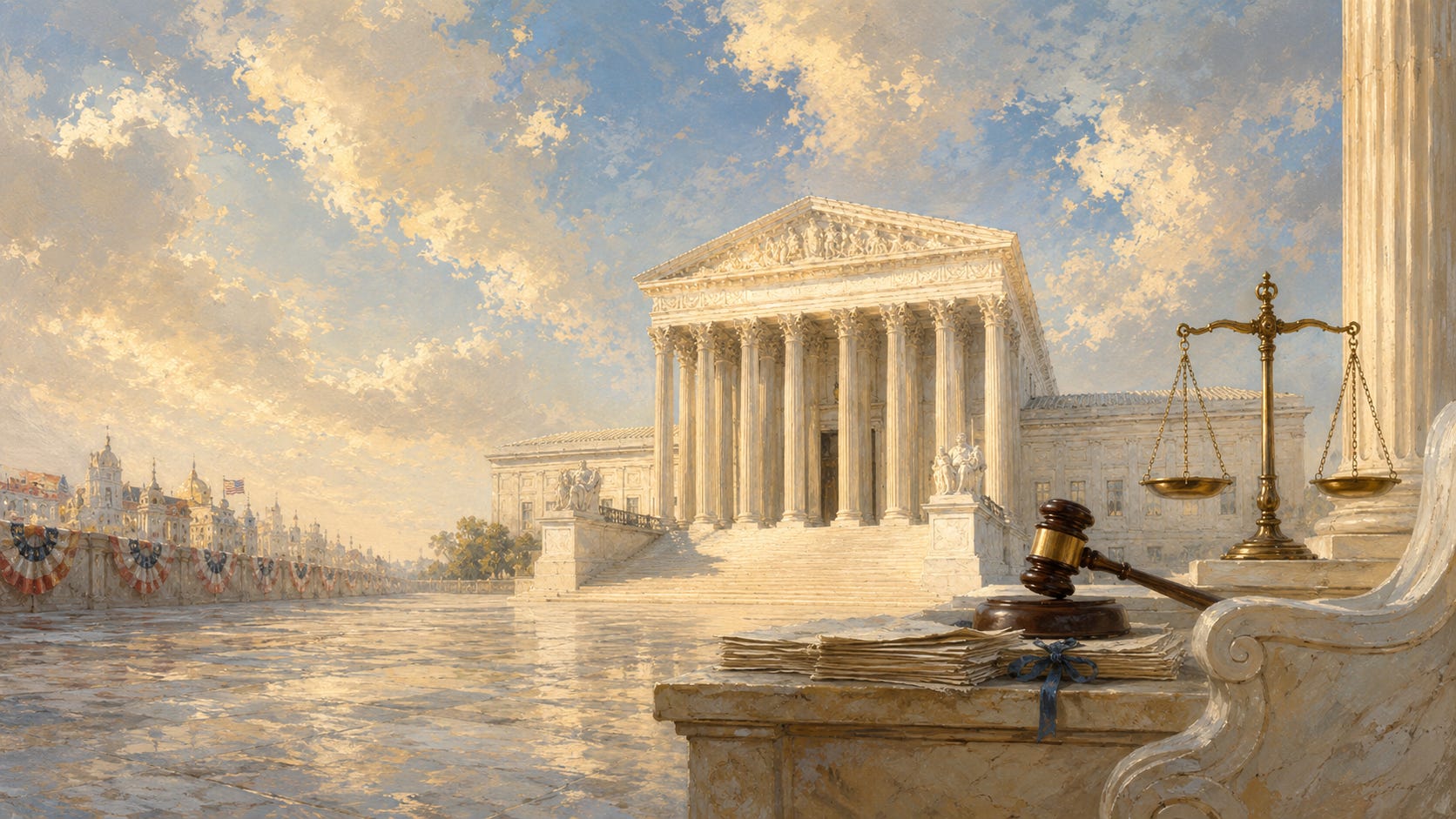
The Rule:
Real power is not only winning while you govern. It is building something that governs after you lose.
People often say the stakes are high with regards to The Supreme Court, because justices can serve for decades. That is true, but it is only the surface. Longevity matters because it allows a political victory to survive the political moment that created it. A president can leave office, a Senate majority can vanish, and the public mood that made both possible can move on. Yet the doctrine created during that moment may continue to govern. That is the hidden prize of judicial power: it lets a coalition survive in the machinery after it has lost the stage.
The Court is not only where legal disputes end. It is where political movements try to outlive the voters.
That is the uncomfortable truth beneath the ritual language. American civics teaches us to see courts as neutral guardians, presidents as temporary stewards, Congress as the voice of the people, and elections as the great instrument of accountability. Some of that is true. None of it fully explains why judicial nominations produce such desperation. The desperation comes from afterpower.
Afterpower is power that keeps operating after its original holder loses direct control. It is not the rally, the campaign, or the executive order announced with cameras in the room. It is the thing left behind that still governs once the room has emptied. That is why the Court becomes more valuable when ordinary politics becomes less stable. When Congress cannot reliably legislate, the presidency becomes more aggressive. When presidents keep reversing one another, every administration looks for the piece of power the next administration cannot easily undo.
A Court appointment is one of those pieces.
The Supreme Court is powerful because it can bind future officeholders who never would have chosen the people doing the binding. A justice appointed by one president can constrain another president years later. A doctrine born from one political era can define the limits of a later one. A movement can lose the next election and still remain alive in constitutional law.
That is not merely durability. It is post-defeat power.
The point is not that law is fake or that judging is only politics in robes. That explanation is too easy. Courts have doctrines, methods, precedents, traditions, and real internal constraints. Judges disagree for reasons that are not always reducible to party. Law matters. Power also matters.
Rulocracy is interested in the place where those two truths meet. Power becomes more durable when it can translate itself into lawful form. A campaign promise can sound partisan. A statute can be repealed. An executive order can look temporary from the moment it is signed. A judicial doctrine carries a different weight. It appears less like a demand and more like an answer.
That is why power wants the robe.
The robe does not eliminate politics. It changes the form politics is allowed to take. It turns yesterday’s victory into today’s principle. It allows a coalition to say, long after the election is over, that the issue is no longer merely what voters want now. It is what the law permits, what the Constitution means, what precedent requires, and what the institution has already decided.
That move changes everything. The winner of the next election does not start from zero. He starts inside a structure built by earlier winners. He may hold office, but the office has already been shaped. He may have a mandate, but the mandate must pass through rules he did not write, judges he did not appoint, precedents he did not choose, and doctrines whose origins may belong to a coalition that has already lost power elsewhere.
That is why losing does not always end power.
The Machinery of Afterpower
The Supreme Court is the clearest example in American politics, but the same principle exists in every serious institution. The visible leader is rarely the whole system. Behind the leader are appointments, contracts, rules, committees, software, charters, donors, trustees, boards, procedures, and inherited interpretations that continue shaping choices long after the person who set them in motion is gone.
A corporation has its own version. A CEO may leave, but his power may remain in the board he shaped, the successor he selected, the contracts he signed, the incentive plans he approved, the risk structure he normalized, or the operating system every department now depends on. The next CEO may have the title. The old CEO may still own the architecture.
That is afterpower.
A university president may resign, but the trustees, tenure rules, donor restrictions, accreditation pressures, and curriculum structures may continue governing long after the controversy fades. A political party may lose an election, but its redistricting maps, court appointments, procedural rules, donor networks, and state-level offices may keep shaping what the next winners are allowed to do. The visible leader changes. The inherited system remains.
The lesson is simple, but it is not comforting: power is not finished when the officeholder leaves. Sometimes that is when the real test begins.
Anyone can see the person currently sitting in the chair. Fewer people ask who built the chair, who wrote the rules for sitting in it, who controls the next appointment, who decides what the chair is allowed to do, and which decisions will still matter after the current occupant is gone. Those are the questions that reveal durable power.
The public is trained to ask who won. Rulocracy asks what survives the win.
That distinction matters because institutions reward different kinds of ambition. The impatient actor wants the announcement. The durable actor wants the mechanism. The impatient actor wants applause while the room is full. The durable actor wants the room arranged so that even future opponents must move through his design.
This is why court fights are so intense. They are not only fights over law. They are fights over political afterlife. A movement that trusts its future popularity can live through ordinary politics. It can run again, persuade again, legislate again, and accept that reversal is part of the bargain. A movement that fears reversal looks for places where reversal is harder. It looks for courts, boards, charters, permanent offices, and structures that can continue governing after the crowd turns away.
That does not make every use of durable power illegitimate. Societies need stability. Companies need continuity. Courts need independence. Not everything should swing with the latest majority or the angriest week. A system with no durable structures becomes frantic, shallow, and easily captured by the moment.
The danger is not that durable power exists. The danger is that people confuse visible accountability with actual control. An election can change the people onstage without changing the structure behind them. A new CEO can inherit a company whose real choices were made years earlier. A new president can enter office only to discover that the past is still seated in the institutions he must use.
The Supreme Court is such a powerful metaphor because it shows the difference between holding power and planting power. Holding power means you can act now. Planting power means your choices can act later. The Court is where political movements plant power in appointments, doctrine, and interpretations that future leaders must confront long after the original fight has faded.
The Lesson
Do not only ask who is winning today.
Ask what will still obey them after they lose.
Who has the seat that does not expire? Who controls the rule that cannot be easily rewritten? Who appointed the person who will still be deciding when the coalition changes? Who owns the contract, the charter, the committee, the board, the procedure, the precedent, or the approval right that future leaders must inherit?
Those are not secondary questions. Those are the questions power asks when it is thinking beyond the moment.
The loudest power wants victory. The deepest power wants afterlife.
A president can win the day. A Congress can win the session. A movement can win the moment. The real prize is building something that still governs when you lose.