
The Rule:
Whoever controls the shared moment can turn belonging into power.
That sounds almost too simple, which is probably why people miss it. We are trained to look for power in obvious places: offices, money, laws, titles, platforms, credentials. Those things matter. Still, many of them become powerful only after someone has first learned how to gather people around a shared center.
A championship makes this visible.
Millions of people pause their separate lives and turn toward the same event. They watch at the same time. They refresh the same score. They argue about the same calls. They wear the same colors. For a few hours, people who may agree on almost nothing else agree to care about one thing together.
That is not just entertainment. That is social organization.
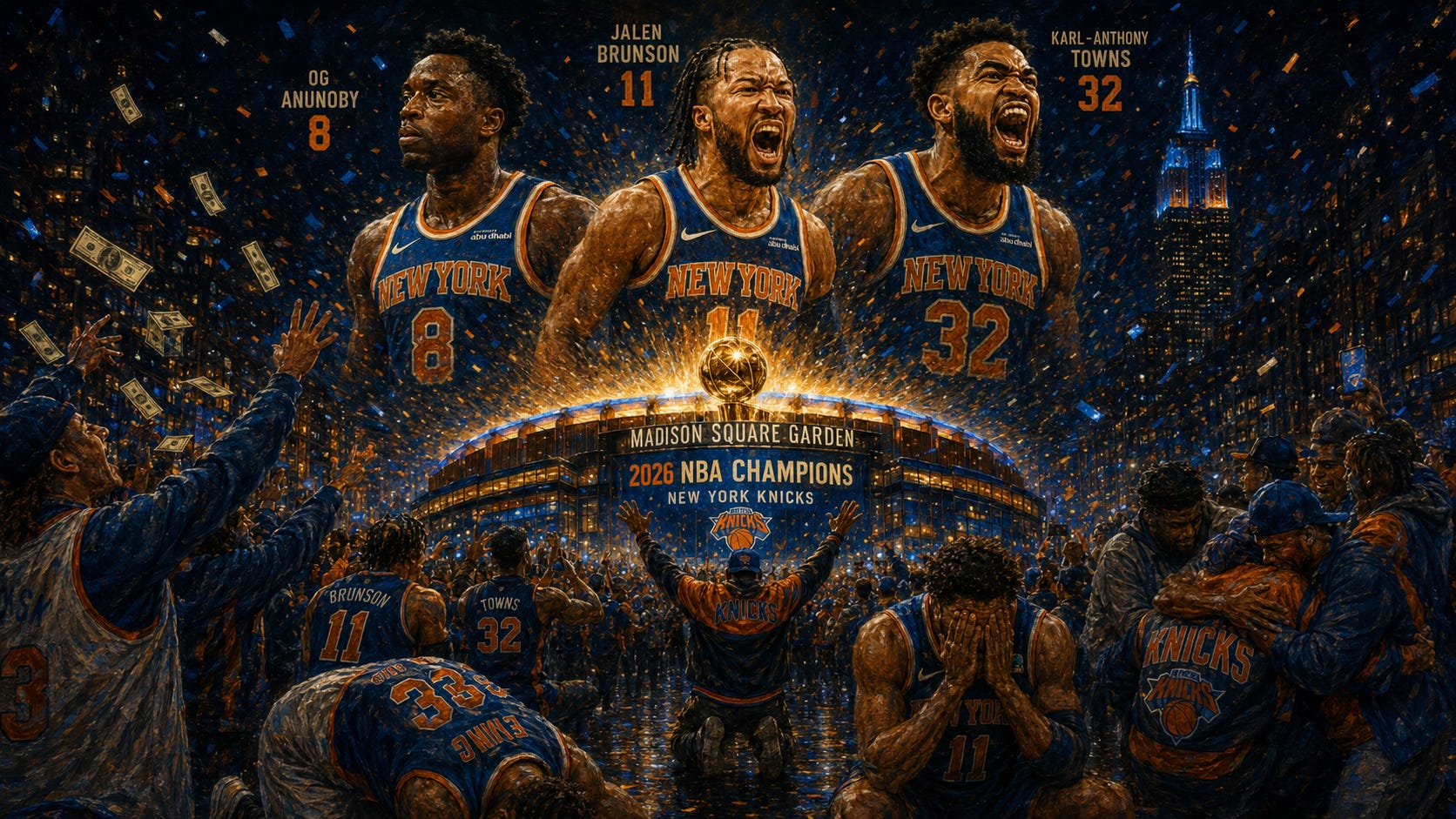
The Knicks winning their first championship since 1973 was, for Knicks fans, joy bordering on disbelief. Decades of frustration, false hope, and sports humiliation were suddenly converted into a shared release. A fan who had suffered for twenty years could look at another fan and not need to explain anything. The memory did the talking.
That is why sports still has power in a fractured society. Most entertainment has become private. We watch different shows, follow different feeds, trust different commentators, and live inside different algorithms. Sports survives because it still creates a common clock. The game begins whether you are ready or not. The comeback happens live. The loss hurts now. The win explodes now.
Shared time is becoming rare.
Rare things become valuable.
The Business of Belonging
The powerful understand this. People will pay for usefulness, but they will pay more for belonging. They will buy products, but they will sacrifice for rituals. They will compare prices for ordinary goods, then spend irrationally when the purchase feels like admission into a memory.
A ticket is not just a seat. A jersey is not just fabric. A broadcast is not just content. Each is a way of entering the shared moment and proving you were close enough to feel it.
Once that kind of gathering exists, money comes from every direction. The league sells the right to watch. The team sells the symbols of belonging. Everyone close to the moment borrows value from the crowd.
That is the part people often misunderstand. The game matters, but the gathering is what makes the game commercially and culturally enormous. A brilliant basketball game played in silence before nobody is athletic achievement. A brilliant basketball game watched by millions becomes an economy.
The powerful do not merely ask, “What can we sell?” They ask, whether openly or instinctively, “Where are people already willing to gather?” Once they find that place, they build tollbooths around it.
This is not unique to sports. A church gathers believers. A university gathers ambition. A platform gathers attention. The form changes, but the rule keeps returning: once people gather around a shared meaning, someone will try to organize, bless, price, govern, or own the gathering.
That does not make every gathering corrupt. That would be too easy and too cynical. Some gatherings are sacred. Some are beautiful. Some are necessary. Life without shared moments would be lonelier and thinner. People need reasons to sit in the same room, stand in the same street, cheer for the same thing, and remember they are not only isolated consumers moving from one private screen to another.
The danger is not that shared moments exist. The danger is that people rarely notice when their belonging has become someone else’s leverage.
Power becomes especially efficient when people experience its machinery as their own desire. Nobody forces a fan to buy the jersey. Nobody forces him to watch the pregame show, argue in the group chat, pay stadium prices, or care about the franchise his grandfather cursed at before he was born. That is precisely why the arrangement is so valuable. Coerced attention is brittle. Voluntary attention compounds.
The most profitable power does not always make people obey. Sometimes it makes them want to return.
Return every season. Return every election. Return every launch day. Return every homecoming. Return every time the app refreshes.
A ritual lowers the cost of loyalty because it gives loyalty a schedule. It tells people when to show up, what to wear, who to oppose, what to remember, and how to recognize one another. Over time, the ritual starts to feel less like something you participate in and more like something you belong to.
That is when the transaction deepens.
A normal business has customers. A powerful ritual has believers. Customers leave when the product gets worse. Believers endure. They explain away failure. They wait for next year. They recruit their children. They turn disappointment into proof of devotion.
A bad restaurant loses people.
A bad sports team can keep them for generations.
That is an extraordinary kind of power. It turns loyalty into an inheritance. It allows institutions to survive incompetence, scandal, drought, and humiliation. It gives the powerful something more durable than a sale. It gives them a claim on identity.
Once identity is involved, ordinary pricing logic starts to weaken. People stop asking only whether the thing is worth the money. They start asking what it would mean not to participate. Would they be less of a fan? Less loyal to the city? Less connected to their father? Less part of the group? Less able to say they were there when it happened?
That question is where belonging becomes profitable.
The powerful gain time, because people organize their lives around the event. They gain money, because participation creates things to sell. They gain loyalty, because memory makes people forgive what a normal customer would not. They gain status, because whoever stands at the center of the crowd borrows importance from the crowd itself.
Status may be the most subtle benefit. Politicians show up. Celebrities sit courtside. Brands attach themselves to the moment. Cities use championships to announce themselves. The event gives importance to everyone close enough to touch it.
That is how a game becomes more than a game.
The Bargain
The powerful rarely say this plainly. They do not need to. They speak in softer language: community, tradition, pride, culture, legacy, fan experience. Some of that language is sincere. Some of it is marketing. Often it is both.
That is the genius of this kind of power. It works best when the feeling is real.
Fake belonging does not last. Manufactured emotion eventually curdles. The strongest systems are built around genuine attachment: real love of a team, real pride in a city, real memory between parent and child. Then the machinery arrives around the real thing.
This is why Rulocracy cannot simply sneer at the crowd. The crowd is not stupid. The crowd is human. It wants meaning, memory, and togetherness. The powerful do not invent those needs. They study them, gather them, package them, and place themselves at the center of their fulfillment.
That is the power move.
A person thinks, “I am watching my team.”
The institution knows, “He is giving us his attention, his emotion, his future purchasing behavior, and a loyalty pattern that may outlive him.”
Both are true.
That is what makes the arrangement so durable. The fan is not wrong to love the team. The institution is not confused about the value of that love.
Once you see this, shared moments start looking different. The question is not only “What are people watching?” The better question is: who benefits because they are watching together?
Who owns the room?
Who sells access to the room?
Who decides who gets closest to the center?
Who turns the emotion into revenue?
Who uses the gathering to become more legitimate than they were before?
Those questions apply far beyond sports. They apply to politics, religion, media, education, technology, work, and family life. Wherever people gather, power is nearby. Sometimes it protects the gathering. Sometimes it exploits it. Usually, it does a little of both.
That does not mean we should stop gathering. We cannot. We should not. A society with no shared rituals becomes a society of strangers scrolling alone. The point is not to become too clever to cheer, too detached to belong, or too cynical to enjoy a parade.
The point is to know the bargain.
When millions gather around one feeling, someone has found a way to turn attention into power. Someone is collecting from the time, the money, the loyalty, and the identity moving through that crowd.
The powerful learned long ago that people do not only pay for products. They pay for proof that they belong.