
I. The Disguise of Delay
In politics and regulation, expiration is rarely an accident. It is often a strategy disguised as neglect.
When a program quietly lapses, it does not always reflect opposition. Often, it reflects calculation. Silence buys time. Missed deadlines create pressure. At just the right moment, the dormant policy is brought back into play, no longer as principle, but as currency.
Consider the Children’s Health Insurance Program, or CHIP. In 2017, it quietly expired for over 100 days without reauthorization. There was no vote to end it. No debate to challenge its merits. The silence was strategic.
At the time, lawmakers were preoccupied with attempts to repeal the Affordable Care Act. Reauthorizing CHIP would have required cooperation across party lines. That would have signaled bipartisan goodwill, which risked undermining the push to dismantle the ACA. CHIP’s expiration became a pressure point. Not to bury it, but to hold it in reserve for the next negotiation cycle.
Children’s healthcare was not denied. It was deferred. Its lapse offered something to trade.
II. The Leverage of Lapse
This tactic is not limited to healthcare. Across many policy areas, expiration functions as a quiet lever.
In 2021, emergency unemployment benefits expired. These programs had sustained millions during the COVID-19 crisis. Their phaseout was framed publicly as fiscal prudence. Behind the scenes, business lobbies had already voiced concern that extended support could discourage labor force participation. Letting the benefits lapse allowed market pressures to reset in the background.
The Child Tax Credit tells a similar story. Temporarily expanded in 2021, it lifted millions of children out of poverty. In 2022, the credit quietly expired. No fierce opposition. No legislative uproar. Its expiration was not due to broad disapproval. It simply became less urgent to those in power once its value as leverage grew.
Letting these programs lapse allowed lawmakers to avoid blame. They never had to vote them down. They simply had to wait them out.
III. Silence with a Clock
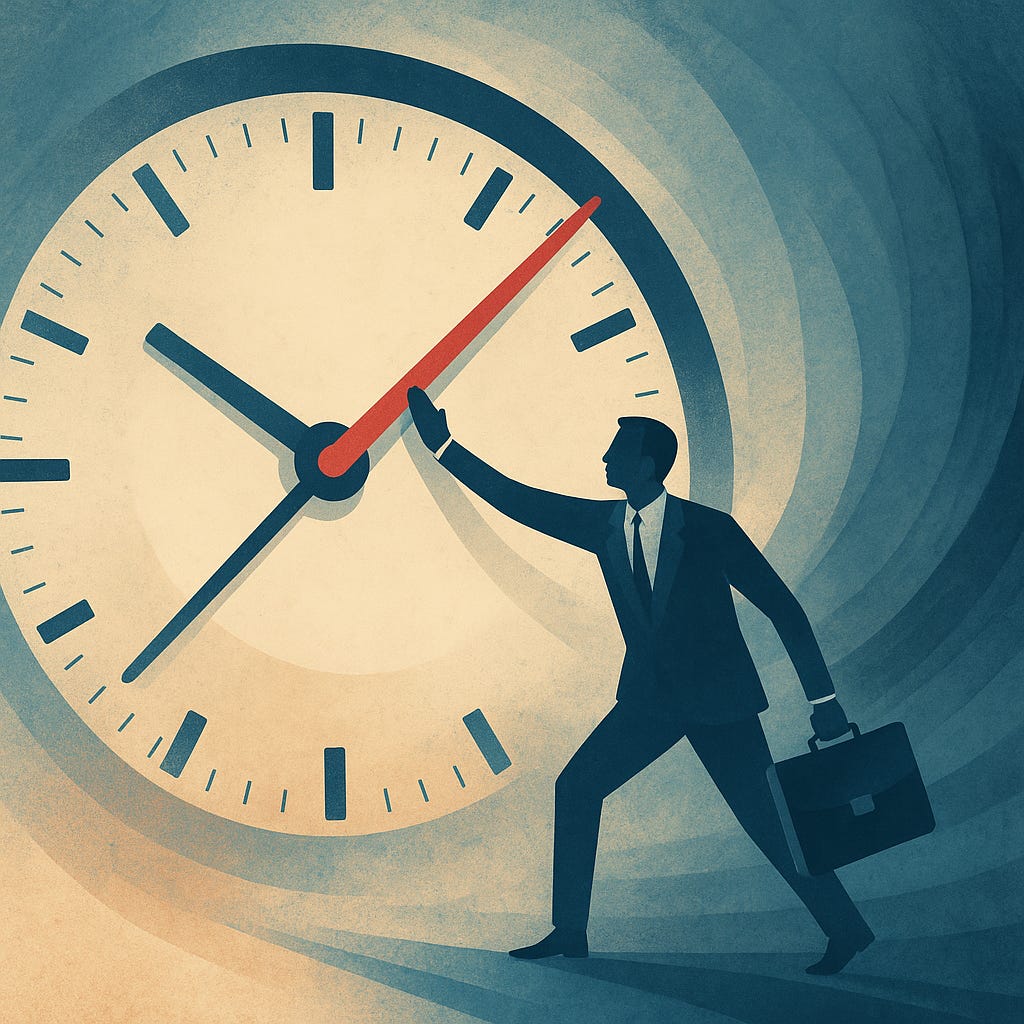
Expiration is not the end of a policy. It is the start of a countdown.
Lobbyists and insiders track these timelines with precision. They know when clauses sunset, when reauthorizations stall, and when urgency can be manufactured. For the public, it may feel like nothing is happening. For those fluent in delay, every quiet moment is a setup.
Policy does not always die in a vote. It dies when time runs out and no one stops the clock.
IV. How to Recognize the Pattern
If you are not inside the machinery, here is how to see expiration for what it is:
If a widely supported program lapses without public explanation, ask who benefits from the delay.
If negotiations begin only after a program expires, ask what that silence was meant to buy.
If a benefit disappears quietly, look for new private actors who are ready to fill the vacuum.
Expiration is not a mistake. It is a method.
Final Reflection
Most people think policies live or die by votes. But power often moves without sound. Expiration offers plausible deniability. No one needs to object to the program. They just need to stay quiet until the deadline passes.
When you understand that silence is structure, not absence, you stop waiting for the noise. You start reading the calendar.
If this helped you see the system more clearly, consider subscribing. Each week brings a sharp, grounded analysis of how law, policy, and silence shape real lives. Clarity is not a luxury. It is a skill worth practicing.
Sources
Georgetown University Center for Children and Families
https://ccf.georgetown.edu/2018/01/23/congressional-debate-over-chip-highlights-need-for-stable-long-term-funding/Federal Reserve Bank of St. Louis
https://www.stlouisfed.org/publications/regional-economist/2022/aug/employment-effects-pandemic-emergency-unemployment-benefitsAmerican Journal of Public Health
https://ajph.aphapublications.org/doi/10.2105/AJPH.2025.308105