
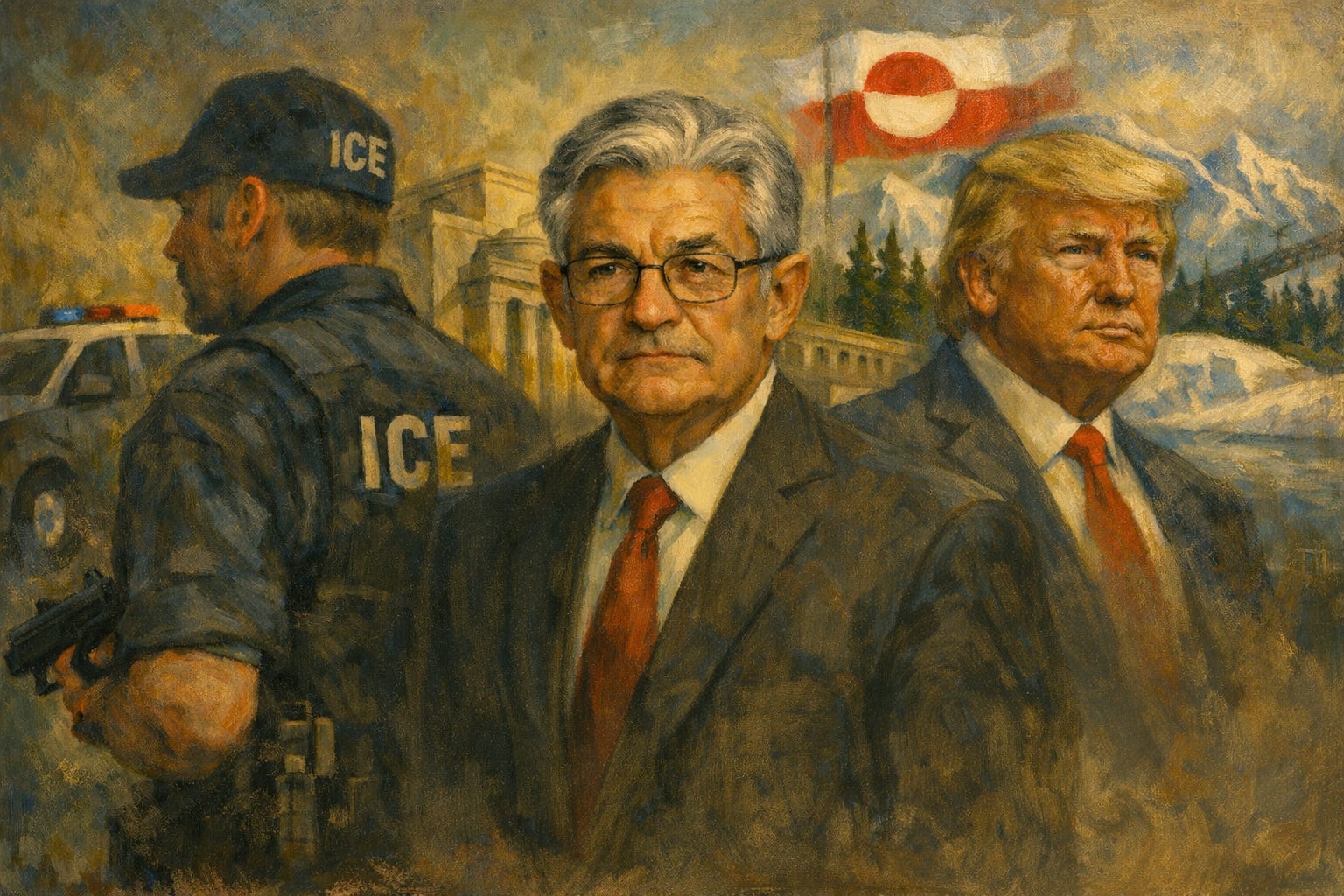
I. Three Unrelated Stories That Are Not Unrelated
In recent weeks, three stories moved through the news cycle with very different surface meanings.
In Minneapolis, a U.S. citizen was killed during an operation involving U.S. Immigration and Customs Enforcement. Video circulated. Protests spread nationally. Judgment formed before any official account could stabilize.
In Washington, markets reacted sharply to renewed public pressure on the Federal Reserve. Former officials warned about independence. Commentators questioned motive. Investors priced uncertainty. Monetary policy itself did not change.
At the same time, U.S. officials convened talks involving Greenland. No treaty was proposed. No sovereignty claim advanced. Still, allies and analysts treated the meeting as a signal that long settled assumptions about predictability and restraint might no longer hold.
Each story belongs to a different domain. Law enforcement. Monetary policy. Foreign affairs.
They converge on the same fault line.
Trust no longer waits for institutions to finish speaking.
II. The Collapse of Deference
For decades, institutional legitimacy operated on delay.
An incident occurred. An investigation followed. Findings arrived later. The public withheld judgment in the interim. Deference filled the gap between action and explanation.
That gap is gone.
In Minneapolis, the question for many was not what happened but whether they believed federal authorities would ever tell the full truth. The protest response reflected not only outrage at a death but skepticism toward the process that would follow it.
With the Federal Reserve, markets did not wait for statutory change or formal interference. The mere visibility of political pressure was enough to alter expectations. Independence was no longer treated as a settled fact but as a variable.
Greenland fits this pattern precisely. The issue was not the substance of the talks. It was the erosion of confidence that U.S. foreign posture is governed by stable norms rather than improvisation. Allies read ambiguity as risk. Predictability itself became suspect.
In all three cases, institutions retained their formal powers. What weakened was the presumption that those powers would be exercised neutrally, consistently, and above politics.
III. Why This Is Structural, Not Episodic
This erosion will continue because it is driven by conditions that do not reverse.
Information now moves faster than institutional process. Video, commentary, and interpretation arrive instantly. Procedure does not.
Political incentives reward preemptive framing. Every actor benefits from casting doubt early. No one benefits from patience.
Complexity reads as evasion. The more layered the process, the more it appears designed to delay accountability rather than deliver it.
Even restraint is reinterpreted. Silence becomes concealment. Neutrality becomes alignment. Diplomacy becomes threat.
None of this requires conspiracy or malice. It is the natural outcome of institutions designed for a slower, more deferential public encountering an environment that no longer grants either.
IV. Where Power Actually Moves When Trust Thins
When trust erodes, authority does not vanish. It relocates.
People stop asking who is formally empowered and start asking who feels credible. Explanation begins to matter more than mandate. Speed matters more than procedure. Consistency matters more than neutrality.
This is why markets move on rhetoric, not action. Why protests spread before reports. Why allies react to tone, not text.
Institutions still matter. Courts still rule. Agencies still enforce. Central banks still set rates. But their influence is increasingly mediated by external interpreters who fill the trust gap first.
Those interpreters do not need formal authority. They need coherence.
V. The Moment We Are In
This is not a collapse of institutions. It is a reordering of legitimacy.
The ICE shooting was not only about a death. It was about disbelief.
The Federal Reserve reaction was not only about rates. It was about fragility.
Greenland was not about territory. It was about predictability.
Each reveals the same truth. People no longer assume institutions deserve trust until proven otherwise. Institutions now have to earn trust continuously, in public, under pressure.
Those who understand this shift will operate differently. They will not wait for closure. They will not rely on formal status. They will focus on clarity, credibility, and timing.
That is where influence is moving.
Not away from institutions entirely, but away from automatic belief in them.
And once that belief is gone, it does not come back on its own.
If this helped you see the system with sharper eyes, consider subscribing. Each piece offers grounded analysis of how power operates, how rules bend, and how clarity becomes leverage. Understanding the system is not optional. It is an advantage worth cultivating.