
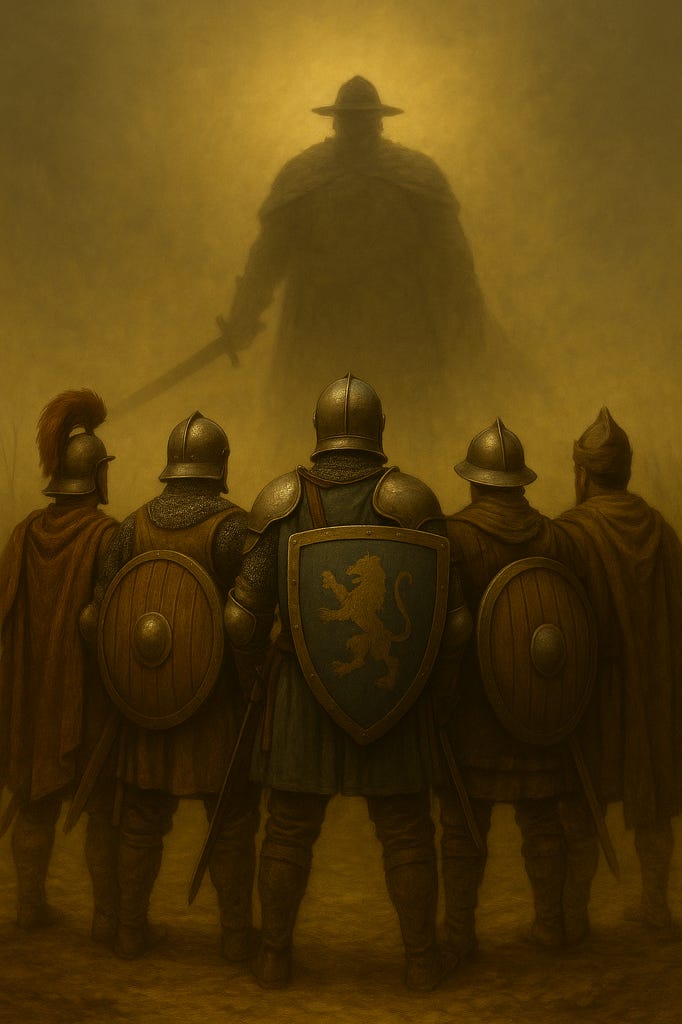
Power multiplies through alignment.
No ruler, movement, or corporation endures alone. Even the strongest command must be reinforced by others whose interests overlap just enough to move in the same direction.
Every system eventually reaches a point where strength alone is insufficient. Isolation, however disciplined, cannot outlast the pressure of organized opposition. The actors that endure learn to align. They discover that survival depends not on control, but on coordination.
When the American colonies faced the British Empire, they did not prevail through muskets alone. They won when France entered the war. A monarchy wounded by pride financed a revolution it feared because its deeper goal was British defeat. That was not friendship. It was mutual calculation disguised as choice.
When Stalin, Roosevelt, and Churchill met in Tehran, they shared no vision of the future. They shared a single requirement: survival. Each understood that victory required a temporary fusion of mistrust, ambition, and endurance. Their alignment reshaped the global order, even as it dissolved into rivalry.
When Lyndon Johnson sought to pass civil rights legislation, he drew strength from movements he could not command. Activists filled the streets, ministers filled the pulpits, and business leaders accepted reform as the price of stability. Their motives diverged, yet their alignment forced the law to bend.
When the largest technology firms unite to resist regulation, their cooperation is rarely idealistic. It is arithmetic. Coordination under pressure, not shared conviction. The unity may fade once the threat passes, but in the meantime, the field tilts in their favor.
This is the power of Alliance Formation.
An alliance converts fragmentation into force. It aligns actors whose interests partially intersect and channels their combined influence in a single direction. It does not depend on affection. It depends on necessity.
Each participant preserves autonomy while contributing to a shared defense or offensive goal. The result is compound leverage. A movement gains scale without central control. A company gains protection without merger. A nation gains security without empire.
It is important to separate this move from what it is not.
It is not partnership. Partnership assumes trust.
It is not truce. A truce suspends conflict, while an alliance channels it toward shared survival.
It is not surrender. Surrender dissolves agency, while alliance distributes it.
An alliance shifts the structure of competition itself. It gives weak actors protection they could not purchase alone. It gives strong actors legitimacy they could not command alone. It rebalances the system by creating scale without consolidation.
A lone voice can warn, but a chorus can alter law.
A single company can innovate, but an aligned industry can rewrite policy.
A solitary nation can defend itself, but a coalition can transform the balance of history.
Every alliance carries decay within it.
Once the shared threat fades, the bond weakens.
The French abandoned their revolutionary allies.
The wartime coalition fractured into Cold War suspicion.
Civil rights unity splintered once victory was achieved.
Alliances are temporary equilibria. They stabilize conflict long enough to move the system, but their cohesion is conditional. The same differences that make alignment powerful eventually make it fragile.
Modern systems rely on this move constantly.
Corporations form trade groups to influence regulation.
Nations align through defense treaties and sanction regimes.
Social movements link arms across ideology to achieve narrow but decisive outcomes.
Each act of alignment alters the field, even if only for a moment. The actors that master this move do not confuse unity with permanence. They understand that alignment is a phase, not an identity.
Power does not always come from control.
Sometimes it comes from coordination.
The art lies in knowing when to align, how to structure the exchange, and when to dissolve it before it decays.
Every system that lasts learns this truth.
Power endures not through purity, but through convergence.
Every throne, if it is to remain standing, must learn how to sit beside another.
If this helped you see the system with sharper eyes, consider subscribing. Each piece offers grounded analysis of how power operates, how rules bend, and how clarity becomes leverage. Understanding the system is not optional. It is an advantage worth cultivating.